Cash runway is the length of time a business can continue before its projected cash balance reaches zero. A useful runway model starts with current cash, adds expected cash inflows, subtracts monthly cash costs, and repeats the calculation period by period.
Runway is not a fixed ratio when revenue, costs, or working capital change. A simple cash divided by burn calculation is a helpful first check, but a monthly forecast is better for decisions because it shows when growth, inventory, marketing, or payment timing changes the burn.
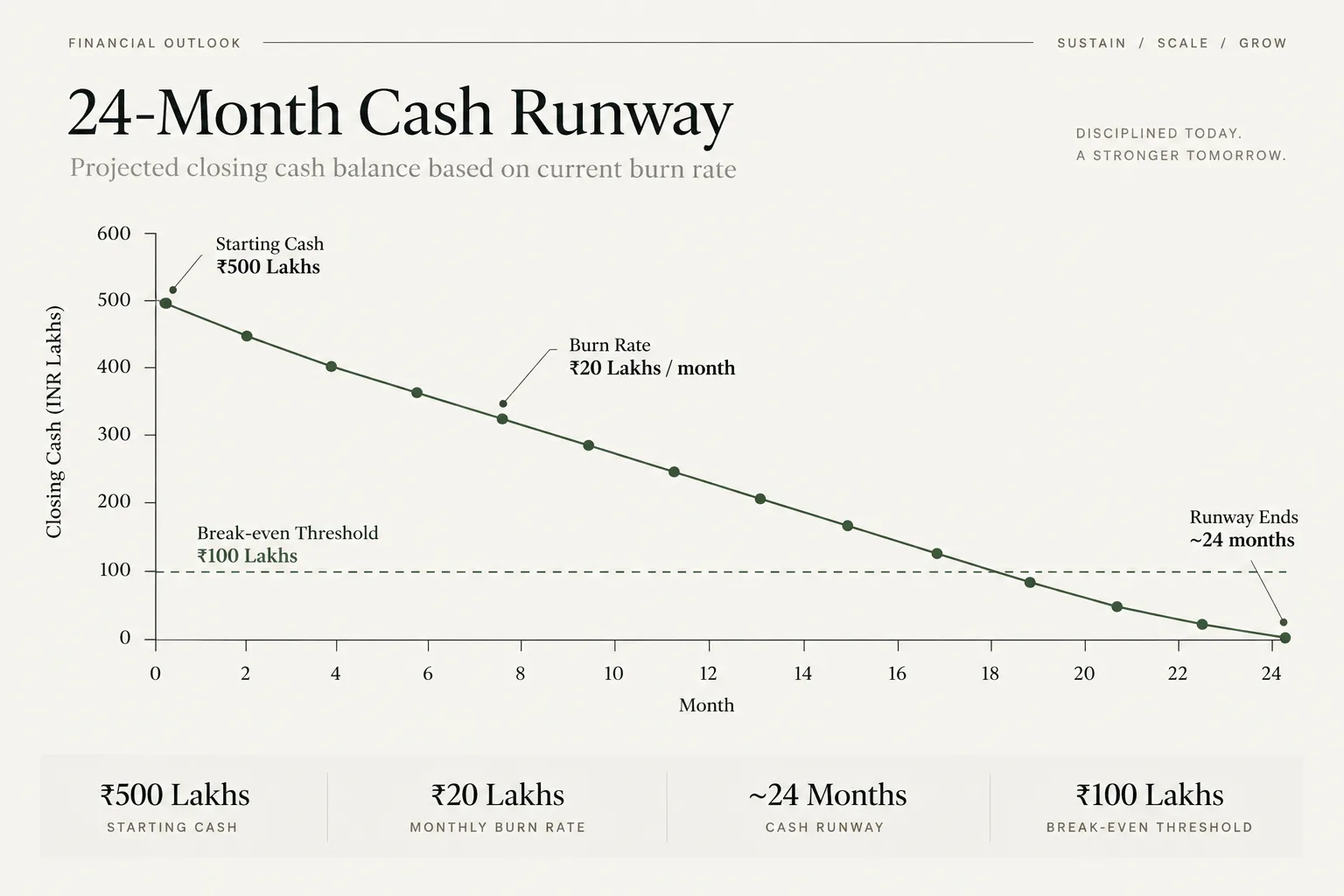
In one minute: calculate closing cash month by month, not only cash divided by current burn, and keep fixed costs, variable costs, and marketing separate so each assumption can change. Break-even month does not recover cash already spent. A detailed cash forecast adds payment timing, inventory, tax, debt, and fundraising, and you should compare conservative, base, and upside scenarios before committing spend.
What is cash runway?
Cash runway describes how long available cash can support operations under a stated scenario. It answers a survival question: if the business follows these revenue and cost assumptions, in which month does closing cash reach zero or below?
Runway differs from profit. A business can report profit but run short of cash because customers pay later or inventory is purchased earlier, or show an accounting loss while cash lasts longer because of upfront customer payments or financing.
The Australian Government’s Guide to managing cash flow recommends using a cash flow statement to see money moving in and out, plan future costs, and identify seasonal patterns through regular updates. A runway view applies that discipline to the date at which available cash could be exhausted.
Runway also differs from break-even. The U.S. Small Business Administration’s Break-even point explains the relationship between fixed costs, selling price, and variable cost. In a monthly runway model, the break-even month is the first month when revenue covers the modelled monthly costs. Earlier cash losses still remain.
How do you calculate cash runway?
For a stable business with constant burn:
Simple runway = current cash / monthly net burnFor changing revenue and costs, calculate every month:
Variable costs = monthly revenue x variable cost rateTotal monthly costs = fixed costs + variable costs + marketing spendClosing cash = opening cash + revenue - total monthly costsThe next month begins with the previous closing cash. In the free calculator, revenue changes by the entered month-over-month growth rate while fixed and marketing costs remain constant. The projection runs for 24 months.
A worked runway example
If a company has ₹600,000 in cash and spends ₹100,000 more than it receives every month, the simple runway is six months.
₹600,000 / ₹100,000 = 6 monthsNow use a monthly scenario:
| Input | Amount |
|---|---|
| Starting cash | ₹600,000 |
| Monthly revenue | ₹300,000 |
| Fixed costs | ₹220,000 |
| Variable costs | 30% of revenue, or ₹90,000 |
| Marketing spend | ₹90,000 |
| Month-one total costs | ₹400,000 |
| Month-one burn | ₹100,000 |
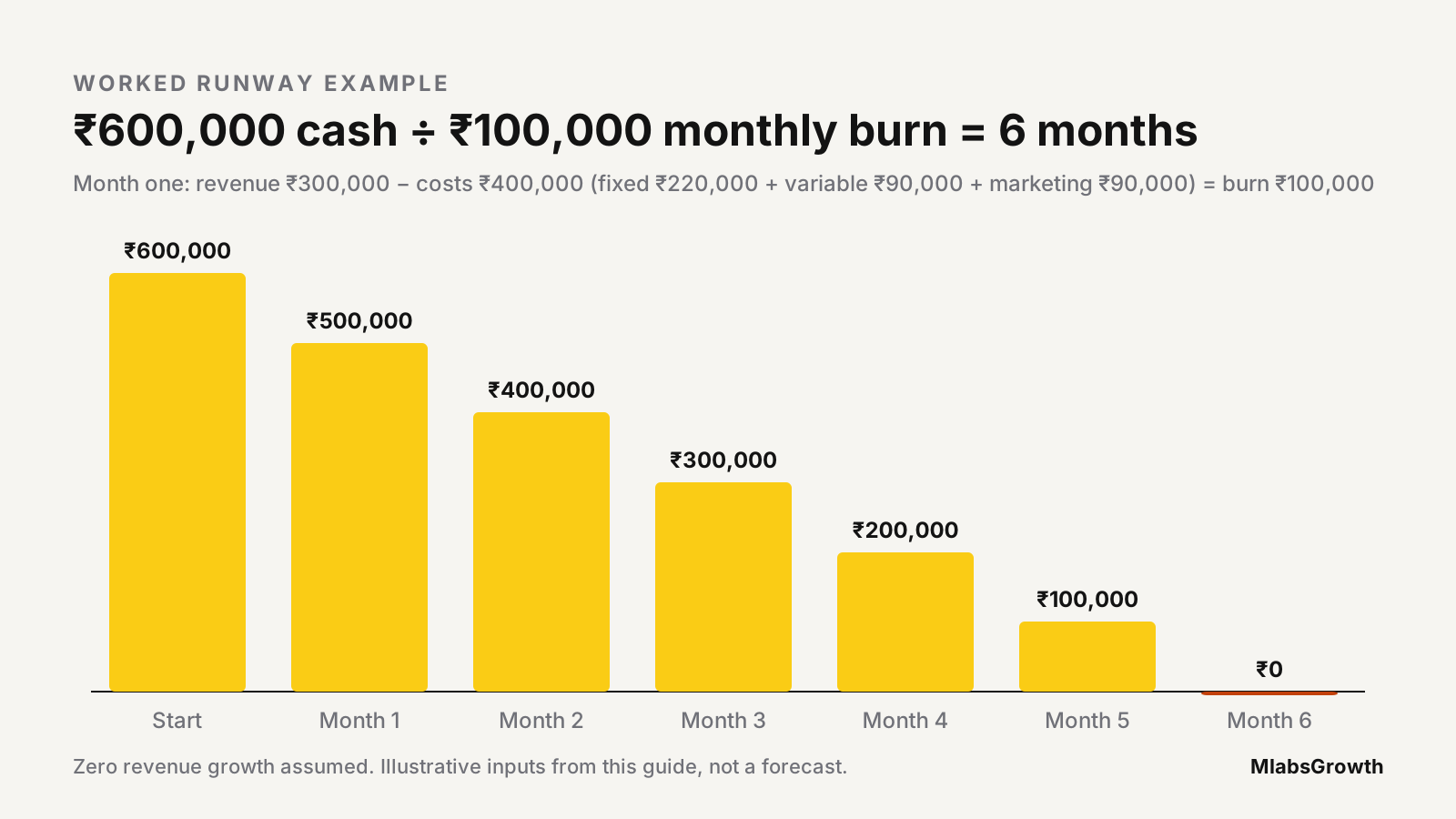
With zero revenue growth, the simple six-month result holds. With positive growth, revenue and variable cost both rise, so the improvement in cash depends on contribution after variable cost. With negative growth, runway can shorten.
That is why changing only the revenue line without its related costs creates false confidence.
Which inputs matter most?
Current available cash
Use unrestricted cash that can fund operations. Exclude amounts held for customers, tax authorities, or other restricted purposes.
Revenue and growth
Use cash timing where possible. Invoiced revenue is not the same as money received. For a scenario, document whether revenue is gross sales, net revenue, or collected cash.
Fixed costs
These can include salaries, rent, core software, insurance, professional fees, and other costs that do not move directly with monthly sales in the forecast horizon.
Variable cost percentage
This represents costs that rise with revenue, such as product cost, fees, fulfilment, and some support. Build it from unit economics rather than choosing a convenient percentage.
Marketing spend
Keep planned marketing separate because it is a management decision and may be paid before revenue settles. Use the marketing budget guide to make the expected return explicit.
What the simple model leaves out
The calculator is a clean operating scenario. A full cash forecast should include material timing and financing events:
- inventory purchase orders and supplier deposits;
- customer payment terms and payment-gateway settlement delays;
- GST, VAT, sales tax, payroll tax, and income-tax payments;
- debt principal, interest, and lease payments;
- annual software, insurance, and licence renewals;
- equipment purchases and one-off projects;
- refunds, chargebacks, and returns;
- fundraising proceeds and transaction costs;
- owner distributions and restricted cash;
- currency movements for cross-border costs.
If inventory is a major use of cash, pair the forecast with the inventory reorder point calculator. A profitable reorder can still create a short-term cash gap.
Running conservative, base, and upside scenarios
Create at least three versions using the same structure:
- Conservative: slower revenue, weaker margin, or delayed collections.
- Base: the operating plan supported by current evidence.
- Upside: stronger performance with the costs required to deliver it.
Then add decision triggers. For example, pause a hire if closing cash falls below a minimum buffer, reduce experimental media if its contribution misses a threshold, or begin financing work before the most likely runway becomes urgent.
Sensitivity matters more than a precise-looking month count. Test revenue growth, variable cost rate, marketing, payroll timing, and one-off inventory orders, and focus on the assumptions that can move the cash-out date materially.
Common runway mistakes
- Dividing cash by one month’s burn when revenue and costs are changing.
- Using booked revenue instead of expected cash receipts.
- Forgetting inventory and tax payment timing.
- Treating break-even month as recovery of earlier losses.
- Assuming revenue grows while fulfilment and support costs stay flat.
- Counting a possible fundraise before it is committed.
- Reading “24+ months” as unlimited runway.
- Waiting until cash is nearly exhausted before defining actions.
Keep the forecast current
Cash runway is a dated scenario, not a permanent fact. The month count is only as current as the opening cash and assumptions behind it, so treat the model as something you rerun rather than something you build once.
Each time you rerun it, recheck the sensitivity inputs, the cash-timing events listed above, and your decision triggers.
Build it month by month, connect revenue to variable cost, and define actions early enough for the forecast to change a decision.
Model your cash runway
See how revenue and costs move cash over 24 months
Use the MlabsGrowth Cash Runway Calculator to project closing cash, first-month burn, and a possible break-even month from your current cash, revenue, growth, fixed costs, variable costs, and marketing spend.
If refunds, returns, or marketing judged on booked rather than collected revenue are eating into cash, see growth and order automation for D2C brands.
The calculator works in your chosen currency and provides a scenario, not financial advice. Add inventory timing, tax, debt, fundraising, and settlement timing in your detailed cash forecast.
Frequently asked questions
How do you calculate cash runway?
Project each month’s closing cash as opening cash plus cash revenue minus fixed, variable, marketing, and other cash costs. Runway ends when closing cash reaches zero or below.
What is monthly burn?
Monthly burn is the cash deficit in a period when modelled costs exceed revenue. It can change as revenue, contribution, payroll, marketing, and working capital change.
Is break-even month the same as cash recovery?
No. Break-even month is when monthly revenue covers modelled monthly costs. It does not repay the cash consumed in earlier months.
Should inventory purchases be included in runway?
Yes for a cash forecast. The simple calculator uses a variable-cost percentage, so large purchase orders, supplier deposits, and payment terms should be added in a detailed model.
What does 24+ months of runway mean?
It means projected cash stays above zero through the calculator’s 24-month horizon, not that the business has unlimited runway.
Source notes
- U.S. Small Business Administration, Break-even point, retrieved 2026-09-19.
- Australian Government, business.gov.au, Guide to managing cash flow, retrieved 2026-09-19.
- Business Development Bank of Canada, Cash runway (glossary), published 2025-04-04, retrieved 2026-10-19.
- Business Development Bank of Canada, Preparing your finances for an economic slowdown, published 2023-02-17, retrieved 2026-10-19.
