A marketing budget should connect money spent to a transparent revenue and order scenario. The basic model allocates a total budget across channels, multiplies each allocation by expected return on ad spend, and divides projected revenue by average order value.
It is a planning tool, not a promise. The most important discipline is separating attributed revenue from contribution and cash: a 3x ROAS can be attractive for one product and unprofitable for another because COGS, shipping, returns, discounts, and customer acquisition economics differ.
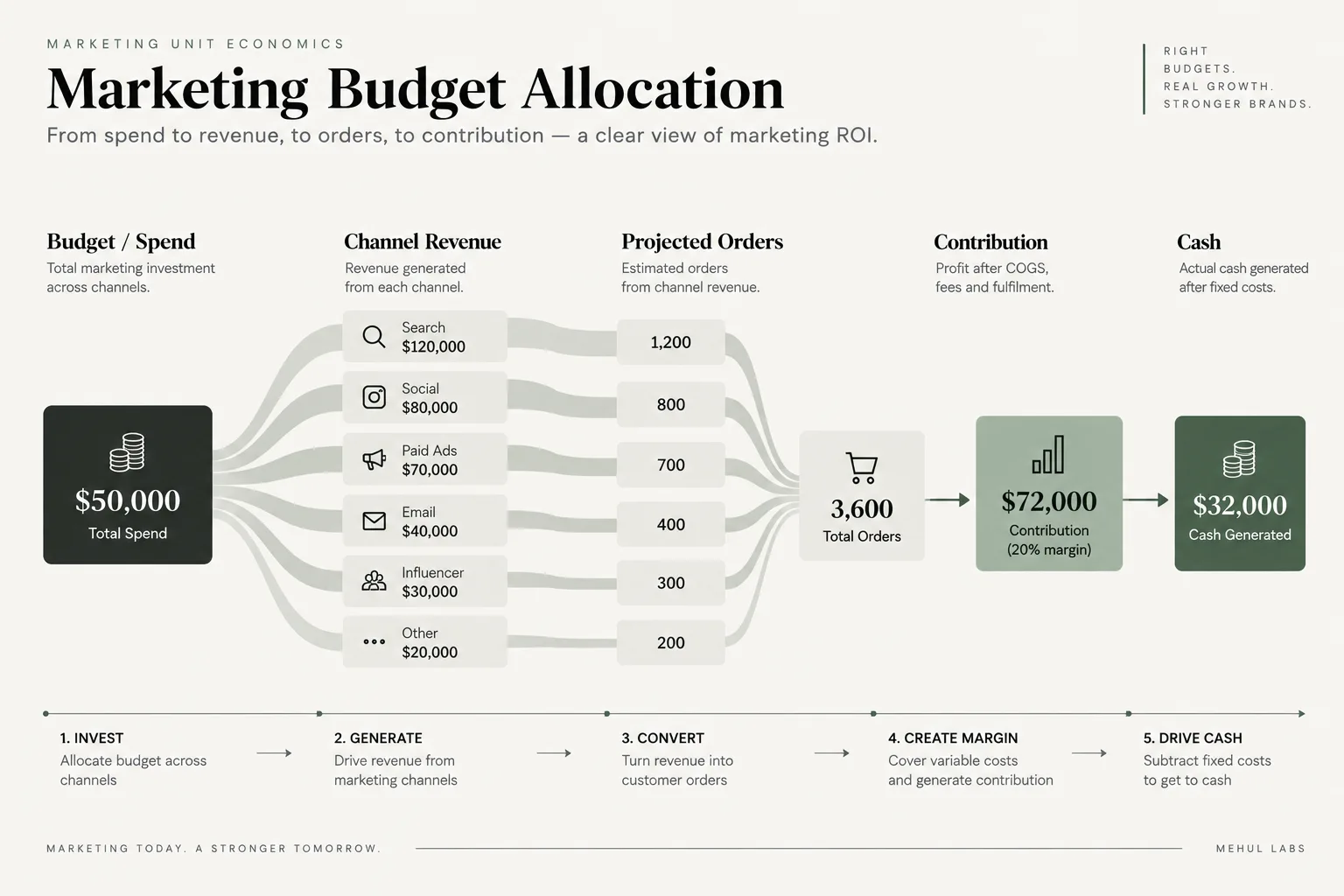
Key takeaways
- Allocate the complete budget so channel percentages total 100%.
- Project revenue channel by channel before calculating blended ROAS.
- ROAS measures attributed revenue, not profit or incremental demand.
- Divide revenue by AOV to estimate orders, then test the result against operational capacity.
- Use ranges and guardrails because efficiency can change as spend scales.
What is a marketing budget model?
A marketing budget model translates a spend ceiling into channel allocations and possible outcomes. It answers: if each channel performs at an explicit ROAS assumption, what revenue, orders, blended ROAS, and cost per order could the plan produce?
Google Ads Help’s Glossary defines ROAS as conversion value divided by cost. That is useful, but conversion value is not the same as cash collected or profit retained. Attribution settings, delayed conversions, cancellations, refunds, tax, and cross-channel overlap can all change the business result.
Use the model for budget negotiation, channel mix planning, scenario comparison, and target setting, but not as proof that a channel will deliver the assumed return.
Calculating a budget scenario in four steps
1. Allocate spend by channel
Channel spend = total marketing budget x channel allocation %The allocations should total 100%. If they total less, some budget is unassigned; if they exceed 100%, the plan spends more than the stated ceiling.
2. Estimate attributed revenue
Channel revenue = channel spend x expected channel ROASProjected revenue = sum of channel revenue3. Estimate orders
Projected orders = projected revenue / average order value4. Calculate blended measures
Blended ROAS = projected revenue / total spendProjected cost per order = total spend / projected ordersThe model calls the last measure cost per order, not measured CAC. New-customer CAC needs the number of newly acquired customers and the full acquisition cost definition.
A worked example at ₹50,000 a month
Assume a ₹50,000 monthly marketing budget, an average order value of ₹1,000, and a blended planning assumption of 3x ROAS.
Projected revenue = ₹50,000 x 3 = ₹150,000
Projected orders = ₹150,000 / ₹1,000 = 150
Projected cost per order = ₹50,000 / 150 = ₹333.33
A channel plan might make the assumptions visible:
| Channel | Allocation | Spend | Expected ROAS | Projected revenue |
|---|---|---|---|---|
| Paid search | 40% | ₹20,000 | 3.5x | ₹70,000 |
| Paid social | 35% | ₹17,500 | 2.5x | ₹43,750 |
| Creators | 15% | ₹7,500 | 2.0x | ₹15,000 |
| Retargeting | 10% | ₹5,000 | 4.25x | ₹21,250 |
| Total | 100% | ₹50,000 | 3.0x blended | ₹150,000 |
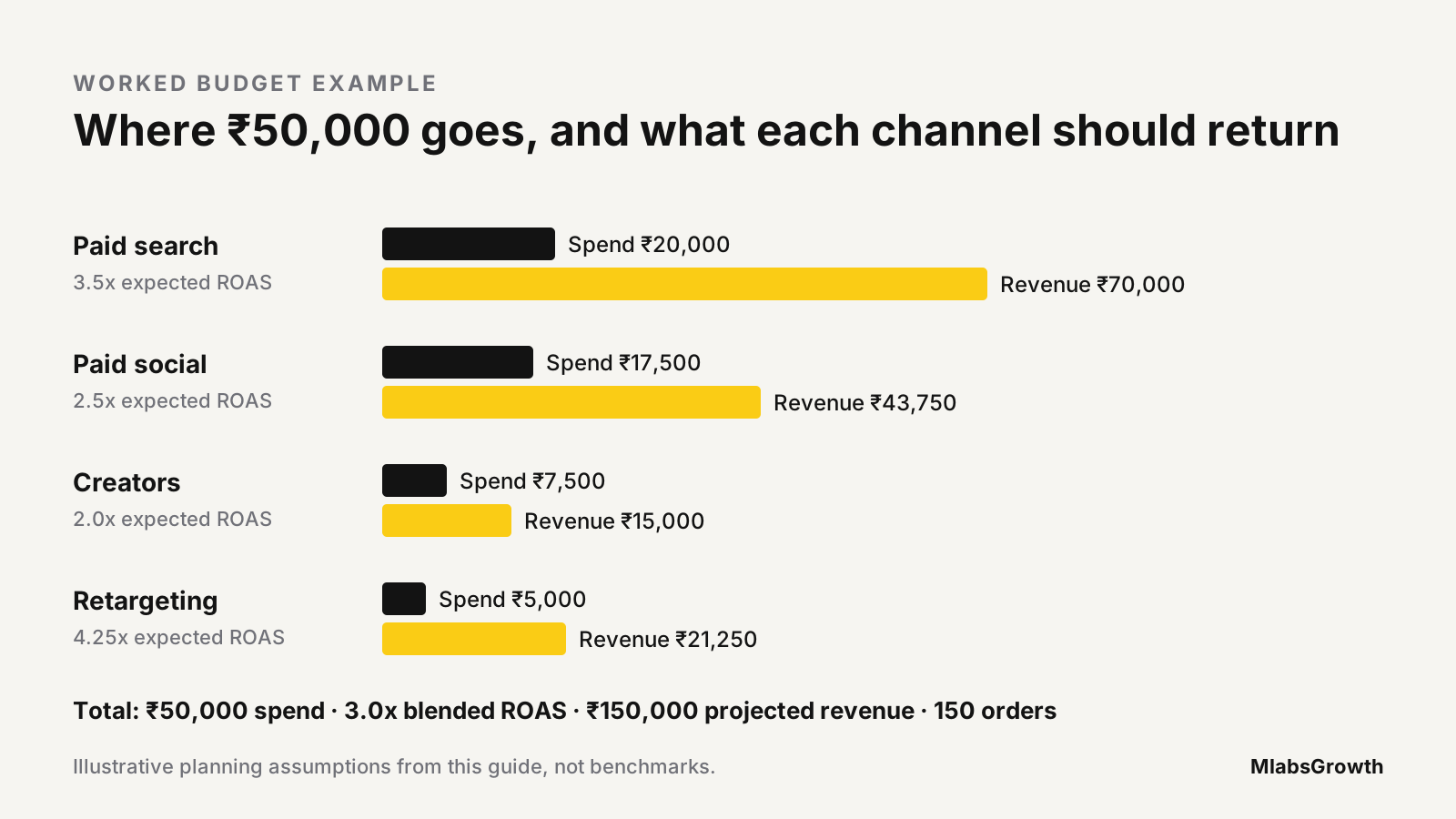
These are illustrative assumptions, not benchmarks. Retargeting can appear efficient because it reaches people influenced elsewhere, and attribution across channels may overlap.
An incrementality test asks a different question: how much additional demand did the advertising cause? Google Ads Help’s Understand your Conversion Lift based on users measurement data describes a method for measuring incremental conversions and incremental ROAS.
How do you turn ROAS into a profit guardrail?
Start with contribution before advertising. If an order generates ₹400 after product, payment, fulfilment, shipping, and expected returns, the maximum break-even ad cost per order is ₹400.
At a ₹1,000 AOV:
Break-even ROAS = AOV / contribution before advertising
Break-even ROAS = ₹1,000 / ₹400 = 2.5x
A 3x attributed ROAS would leave roughly ₹66.67 after advertising per projected order in this simplified example. A 2x ROAS would not cover the modelled pre-ad contribution. For a complete cost map, calculate unit economics first.
This guardrail should vary by product, country, new versus returning customer, and channel, since a blended company target can hide an unprofitable segment.
If ChatGPT Ads is part of the test mix, use the complete guide to ChatGPT Ads for Shopify to separate catalog preparation, campaign objectives, attribution, and store-level profitability.
How should you allocate the budget?
Use evidence and constraints, not equal percentages by default.
- Protect proven demand capture. Fund channels with stable contribution and enough available demand.
- Reserve structured test spend. Define the hypothesis, audience, creative, duration, and stop rule.
- Match spend to capacity. Inventory, fulfilment, support, and cash must handle the projected orders.
- Use marginal efficiency. Historical average ROAS may fall as spend expands into weaker audiences.
- Separate acquisition and retention. Their economics and attribution behave differently.
- Plan a range. Compare conservative, base, and upside ROAS rather than one exact number.
Link the plan to the cash runway calculator. Media is often paid before every order settles, the refund window closes, or a repeat purchase occurs.
Common marketing budget mistakes
- Treating ROAS as profit.
- Entering 300 instead of 3 for a 3x target.
- Allowing allocations to total more or less than 100%.
- Assuming the current ROAS remains constant at higher spend.
- Counting the same conversion across multiple platforms.
- Dividing spend by all orders and calling it new-customer CAC.
- Ignoring taxes, refunds, cancellations, discounts, and returns.
- Planning demand without checking inventory and fulfilment capacity.
- Changing budgets faster than conversion delays can settle.
Frequently asked questions
How do you calculate projected marketing revenue?
Multiply each channel’s allocated spend by its expected ROAS, then add the channel revenue estimates. Keep assumptions visible so actual results can be compared with the plan.
What is the difference between ROAS and profit?
ROAS divides attributed revenue by ad spend. Profit also accounts for product cost, fulfilment, fees, returns, overhead, and other expenses. Incremental revenue can also differ from attributed revenue.
How should a marketing budget be split across channels?
Allocate 100% based on evidence, capacity, and risk. Protect proven activity, reserve a defined test share, and avoid assuming every channel can scale at its historical efficiency.
How do you calculate projected orders?
Divide projected attributed revenue by average order value. The result is a scenario and depends on conversion, attribution, cancellations, refunds, and the stability of AOV.
How often should a marketing budget be reviewed?
Review pacing and leading indicators weekly, reconcile attributed and settled results monthly, and reset assumptions when spend, offer, channel mix, or tracking changes materially.
Build a channel plan
ROAS starts the conversation; it does not finish the financial analysis. Build the plan so every assumption stays visible, then hold it against contribution and cash.
Turn a spend ceiling into a transparent scenario
Use the MlabsGrowth Marketing Budget Calculator to allocate spend by channel and estimate projected revenue, orders, blended ROAS, and cost per order.
If the plan needs a team to brief, produce and run the campaigns from your approved brand context, see our AI marketing workflow automation service.
The calculator works in your chosen currency and uses your assumptions. Actual performance depends on traffic, offer, conversion, attribution, and how channel efficiency changes with scale.
Source notes
- Google Ads Help, Glossary, retrieved 2026-09-19.
- Google Ads Help, Understand your Conversion Lift based on users measurement data, retrieved 2026-09-19.
- Google Ads Help, Find out how long it takes for your customers to convert, retrieved 2026-10-19.
- Google Ads Help, About attribution models, retrieved 2026-10-19.
