Bundle pricing combines products into one offer at a defined selling price, which Google Merchant Center also treats as a distinct bundle product type. A useful bundle can raise average order value, simplify a buying decision, and move complementary stock. A weak bundle merely gives away margin on products customers would have bought anyway.
The calculation begins with list value, discount, and total product cost. It ends with contribution, adoption, and incremental profit. Keeping those stages separate, and checking cash margin and margin percentage rather than only the new order value, prevents an attractive revenue projection from disguising an unprofitable offer.
What is bundle pricing?
Bundle pricing offers two or more products together, often for less than their combined individual prices. Shopify Help Center’s Product bundles describes bundles as multiple products sold together, including fixed bundles, multipacks, and mix-and-match offers.
The commercial value can come from several places: a larger basket, better product discovery, lower acquisition cost per item, simpler selection, or movement of complementary inventory.
The discount itself is not the strategy. The offer must create a reason to buy the set.
Common formats include:
- Fixed set: a predefined group such as a skincare routine.
- Multipack: several units of the same product.
- Mix and match: the customer selects from an eligible range.
- Buy more, save more: quantity tiers with increasing discounts.
- Starter kit: the minimum products needed to reach a first result.
For a same-product offer, the Shopify quantity breaks worked model shows how to set profitable price tiers before choosing an app or native discount.
How do you calculate a bundle price?
Use five steps.
1. Add the individual selling prices
Bundle list value = sum of individual product prices2. Apply the bundle discount
Bundle selling price = list value x (1 - discount rate)3. Add product costs
Total bundle COGS = sum of product costs4. Calculate product-level bundle margin
Bundle margin = bundle selling price - total bundle COGSBundle margin % = bundle margin / bundle selling price x 1005. Add the costs required to complete the order
Bundle contribution = bundle selling price
- product costs
- payment fees
- pick, pack and packaging
- shipping subsidy
- expected return cost
- acquisition cost allocated to the order
The calculator reports product-level margin so that the price logic stays clear. Use the unit economics guide to extend the result through fulfilment and acquisition.
A worked bundle example
Assume two complementary products sell individually for ₹600 and ₹400, with product costs of ₹270 and ₹180.
| Item | Calculation | Result |
|---|---|---|
| Bundle list value | ₹600 + ₹400 | ₹1,000 |
| Discount | ₹1,000 x 10% | ₹100 |
| Bundle selling price | ₹1,000 - ₹100 | ₹900 |
| Total COGS | ₹270 + ₹180 | ₹450 |
| Product-level margin | ₹900 - ₹450 | ₹450 |
| Product-level margin rate | ₹450 / ₹900 | 50% |
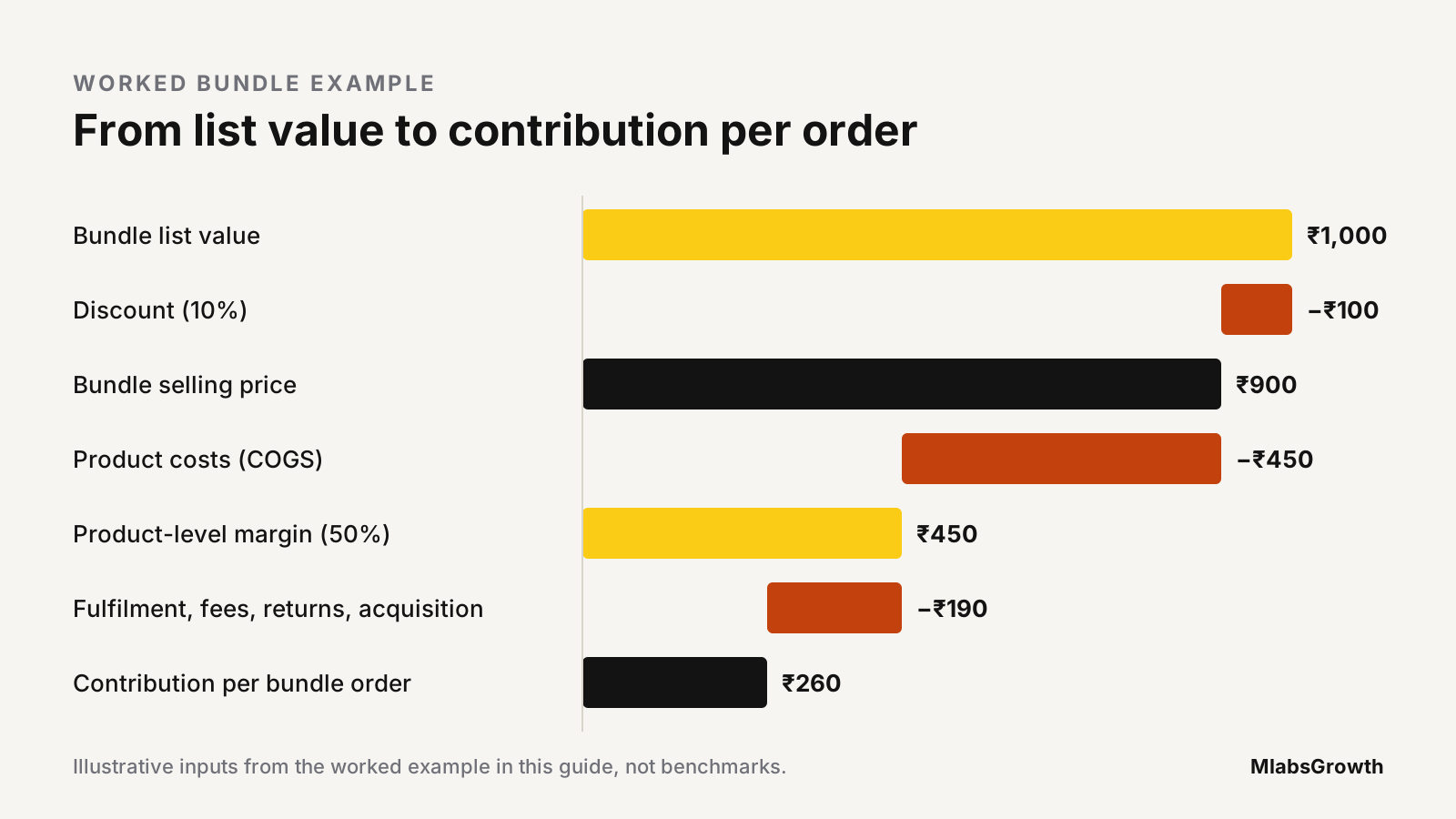
The customer saves ₹100 and the seller retains ₹450 before fulfilment, fees, returns, and acquisition. If those additional variable costs total ₹190, contribution becomes ₹260, and that is the number to compare with a single-item order and with fixed-cost requirements.
Suppose the current average product price is ₹500. A ₹900 bundle can lift the value of adopted orders, but not every customer will choose it.
A scenario with 20% adoption is a planning assumption. It is not evidence that order value or total orders will rise by a specific amount.
How should you choose a discount?
Work backwards from the minimum acceptable contribution. If the company needs ₹250 contribution and the non-product variable costs are ₹200, the bundle must leave at least ₹450 after COGS.
Minimum bundle price = COGS + other variable costs + required contributionFor the example above, ₹450 + ₹200 + ₹250 = ₹900. A deeper discount would miss the target unless it reduces another cost or produces reliable incremental demand.
Compare at least three scenarios: no discount, the proposed discount, and the maximum discount the economics can support. This sensitivity view is more useful than copying a competitor’s percentage.
Six checks for a compelling bundle
A bundle should have a clear customer logic. Products that complete one routine, solve one job, replenish together, or create a meaningful quantity saving are easier to understand than an arbitrary group of stock.
Use these checks:
- Complementarity: customers have a credible reason to use the items together.
- Visible value: the individual total and bundle saving are easy to compare.
- Choice clarity: the shopper can understand what is included without opening multiple pages.
- Margin room: the economics survive fulfilment, payment, returns, and acquisition.
- Operational fit: components are in stock, pickable, and represented correctly in inventory.
- Testability: adoption, conversion, contribution, and returns can be measured against a baseline.
Bundles can create inventory complications because every component must be available. If one low-stock SKU blocks the set, the offer may disappear while other products remain abundant. Connect promotion planning with the inventory reorder point calculator.
Forecasting and measuring bundle impact
The planning model uses current orders, an adoption assumption, and a conversion-uplift assumption. These inputs help compare scenarios, but they should never be described as predicted customer behaviour.
Track actual results using:
- bundle view-to-purchase conversion;
- bundle adoption as a share of eligible orders;
- average order value for exposed and unexposed shoppers;
- contribution per visitor and per order;
- component stockouts and fulfilment time;
- returns for the complete bundle and individual items;
- cannibalisation of full-price individual purchases.
The strongest measure is usually incremental contribution per visitor, not bundle revenue alone, because a bundle can increase AOV while reducing conversion or discounting demand that already existed.
Common bundle pricing mistakes
- Applying a discount before adding all product costs.
- Comparing bundle AOV with a single item but ignoring unit quantity.
- Treating an adoption assumption as a forecast.
- Ignoring pick, pack, packaging, payment, and shipping costs.
- Bundling unrelated products to clear stock without a customer benefit.
- Creating too many choices and making the decision harder.
- Failing to synchronise component inventory.
- Measuring revenue lift without checking cannibalisation and contribution.
Frequently asked questions
How do you calculate a bundle price?
Add the individual product prices and multiply the total by one minus the discount rate. Then subtract combined product cost to check margin and add all order-level variable costs before judging contribution.
What is a good bundle discount?
There is no universal rate. The discount should create clear customer value while leaving enough contribution after product, fulfilment, payment, returns, and acquisition costs.
Does a bundle always increase profit?
No. Higher order value can still produce lower profit if the discount and incremental costs consume the gain. Cannibalisation can also discount purchases that would have happened at full price.
What is bundle adoption?
Bundle adoption is the assumed or observed share of eligible orders that choose the bundle. Use it for scenarios, then replace the assumption with measured test data.
How many products should a bundle contain?
Use the smallest set that solves a clear customer need. The calculator accepts two to five products, but choice clarity and operational reliability matter more than item count.
Model a bundle before launch
Bundle pricing works when the customer sees useful value and the business keeps adequate contribution. Calculate the list value, discount, product cost, and margin first. Then add order-level costs and test adoption against a baseline.
Test the price, margin, and adoption scenario
Use the MlabsGrowth Bundle Pricing Calculator for two to five products. It calculates list value, discounted selling price, total COGS, product-level margin, and a projected order-value scenario.
To test bundles and other cart additions against order value and margin on a live store, see our Shopify conversion optimization service.
Adoption and conversion uplift are assumptions, not predictions. The calculator works in your chosen currency and excludes fulfilment, fees, returns, and acquisition from bundle margin.
Source notes
- Shopify Help Center, Product bundles, retrieved 2026-09-19.
- Google Merchant Center Help, Bundle [is_bundle], retrieved 2026-10-19.
- OpenStax, Principles of Accounting, Volume 2: Managerial Accounting, section 3.1 on contribution margin, published 2019-02-14, retrieved 2026-10-19.
