Return to origin, or RTO, turns an apparently successful order into a failed delivery with real operating costs. The seller may pay forward freight, reverse freight, and packaging without collecting the expected revenue.
Putting a number on that cost shows where confirmation, address quality, courier selection, or payment incentives can protect contribution margin. The most useful model makes two separations: direct cash cost apart from revenue at risk, and cash-on-delivery orders apart from prepaid orders. Without them, teams either treat the full order value as an accounting loss or hide a weak COD segment inside a blended average.
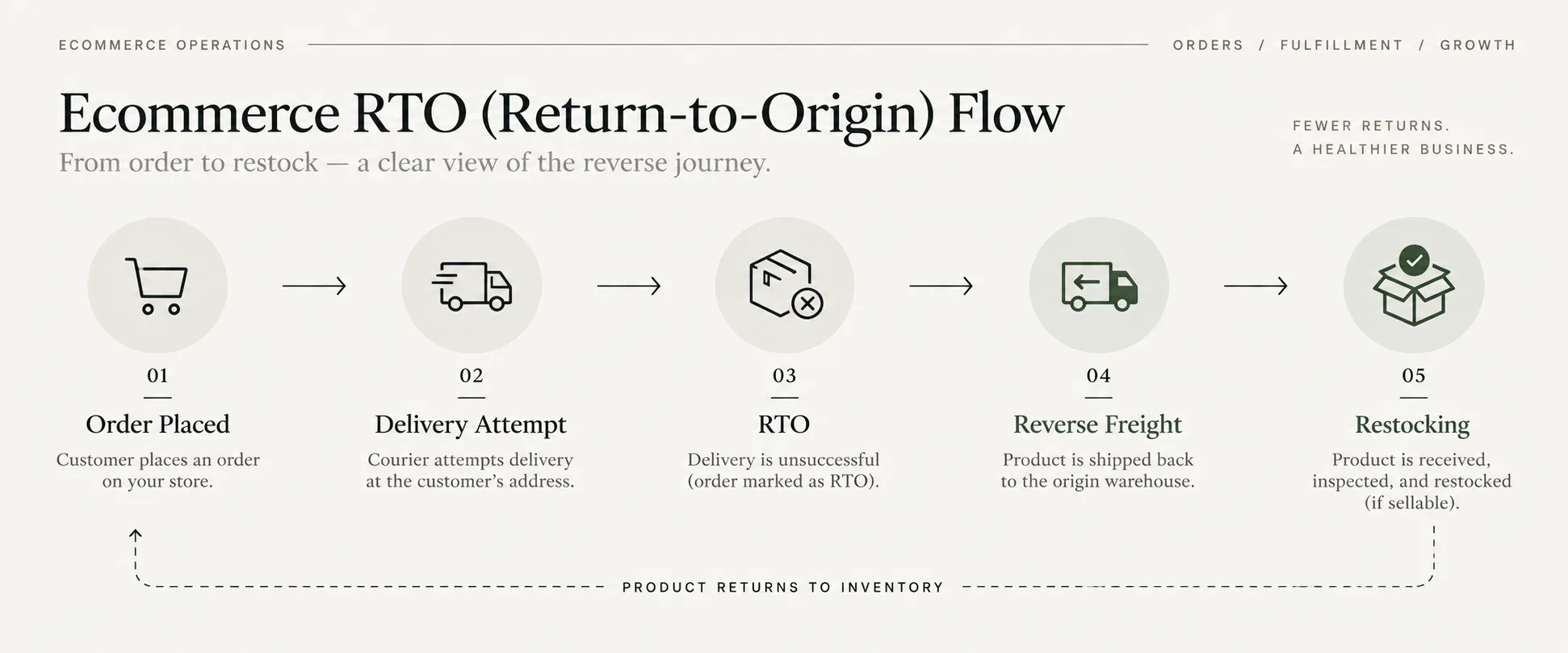
The short version: direct RTO cost is returned orders multiplied by forward freight, reverse freight, and packaging. Revenue at risk is not the same as realised loss or lost profit. Calculate COD and prepaid RTO independently before viewing the blended result, segment failures by courier, postcode, product, acquisition channel, and reason code, and use a target RTO rate to estimate avoidable cost. Then validate any savings with actual delivery data.
What RTO means, and how it differs from a return
RTO occurs when an ecommerce parcel is returned to the origin because delivery was not completed. Common causes include an incorrect or incomplete address, a customer refusing the shipment, repeated failed attempts, inability to contact the customer, a delayed delivery, or a courier serviceability problem.
RTO is different from a normal post-delivery return. In an RTO event, the customer usually never accepts the parcel. That matters because payment collection, return reasons, inventory condition, and courier charges can all differ.
The unit to count is a settled order outcome.
Do not calculate the rate while a large share of orders is still in transit. Use one consistent order cohort and allow enough time for delivered and returned statuses to settle.
Why a rate alone hides the cost
Ten failed deliveries on lightweight local parcels can cost less than five failed deliveries to remote zones. An RTO rate does not show that. Converting failure rates into money lets a team prioritise the specific routes, couriers, offers, and customer segments that deserve attention, and it supports practical decisions:
- whether a COD confirmation flow pays for itself;
- where prepaid incentives may be affordable;
- which courier performs best for a region;
- whether a campaign is attracting low-intent orders;
- how much RTO allowance belongs in unit economics;
- whether a reduction target is large enough to matter.
There is a working-capital effect too. Stock can be unavailable while it travels out and back, and it may return too late or damaged. The simple direct-cost calculation does not fully price that delay. Treat it as a clear starting point, not a complete profit-and-loss estimate.
How to calculate RTO cost
Start by calculating returned orders for each payment type.
COD RTO orders = total orders x COD share x COD RTO ratePrepaid RTO orders = total orders x prepaid share x prepaid RTO rateThen calculate the cost attached to a failed shipment.
Direct cost per RTO = forward freight + reverse freight + packagingTotal direct RTO cost = total RTO orders x direct cost per RTOKeep expected sales value in a separate line:
Revenue at risk = total RTO orders x average order valueRevenue at risk is not net loss. The seller may recover and resell the product: product cost can remain in inventory even though freight and packaging have already been consumed. The direct formula can also cut the other way, understating the damage when stock is lost, damaged, discounted, or handled repeatedly.
A worked RTO example
Assume a store receives 1,000 monthly orders with a ₹1,200 average order value. COD represents 60% of orders and has a 20% RTO rate. Prepaid orders have a 5% RTO rate.
These rates are assumptions for the example, not benchmarks. Published figures mostly come from payment and logistics vendors. For example, Razorpay estimates a 25–30% RTO rate for COD orders in India against 2–3% for prepaid. Treat vendor ranges as context and replace them with your own settled courier data. The same method works in any currency and any market where you offer pay-on-delivery.
| Item | Calculation | Result |
|---|---|---|
| COD RTO orders | 1,000 x 60% x 20% | 120 |
| Prepaid RTO orders | 1,000 x 40% x 5% | 20 |
| Total RTO orders | 120 + 20 | 140 |
| Cost per RTO | ₹80 forward + ₹80 reverse + ₹20 packaging | ₹180 |
| Direct RTO cost | 140 x ₹180 | ₹25,200 |
| Revenue at risk | 140 x ₹1,200 | ₹168,000 |
The business has ₹25,200 in modelled direct logistics and packaging cost. The ₹168,000 figure describes sales value attached to failed deliveries, not profit lost, and keeping the two apart is what makes the result usable in financial planning.
Now set a target. If the target COD RTO rate is 15%, COD RTO orders fall from 120 to 90, a difference of 30 orders. At ₹180 each, the modelled avoidable direct cost is ₹5,400.
That is a scenario, not a promised saving.
Costs a deeper RTO model can add
The free calculator intentionally keeps the direct formula transparent. A deeper internal model can add costs that your records support:
- courier surcharges, reattempt fees, and remote-area charges;
- call-centre or support time used to confirm and recover orders;
- warehouse receiving, quality checks, repacking, and restocking;
- damaged, expired, opened, or unsellable inventory;
- payment fees that are not refunded;
- discounts needed to resell returned stock;
- inventory carrying cost during the delivery and return cycle;
- lost contribution when stock is unavailable for another buyer.
Avoid adding the full product cost automatically if saleable stock returns to inventory; use the expected unrecoverable portion instead. You are building a decision model, not the largest possible loss estimate.
How can you reduce RTO without blocking good orders?
Begin with diagnosis, not a blanket rule. A sharp increase may come from one postcode cluster, one courier, one landing page, one SKU, or one promotion.
- Improve address quality. Validate addresses at checkout, check postcodes, highlight missing fields, and let customers correct obvious errors before dispatch.
- Confirm high-risk COD orders. Use proportionate SMS, WhatsApp, or call confirmation for segments with evidence of failure.
- Set honest delivery expectations. Show serviceable dates and communicate delays before the parcel reaches the doorstep.
- Route couriers by performance. Compare settled delivery outcomes by region instead of using one national average.
- Offer a sensible prepaid incentive. Compare the incentive cost with avoided RTO cost and payment economics.
- Review acquisition quality. Campaigns optimised for cheap orders can attract low purchase intent.
- Use reason codes. Separate refusal, address error, unreachable customer, delay, damage, and serviceability failures.
COD itself is not the only problem. Removing it can reduce accessible demand in markets where customers prefer it, so measure the net effect on delivered orders and contribution rather than the RTO percentage alone.
Confirmation is usually the first step to automate, because it targets orders before they ship. The AI calling guide for COD confirmation covers scripts, timing and human handoff, and our COD confirmation and order automation service sets the workflow up with your courier and order data.
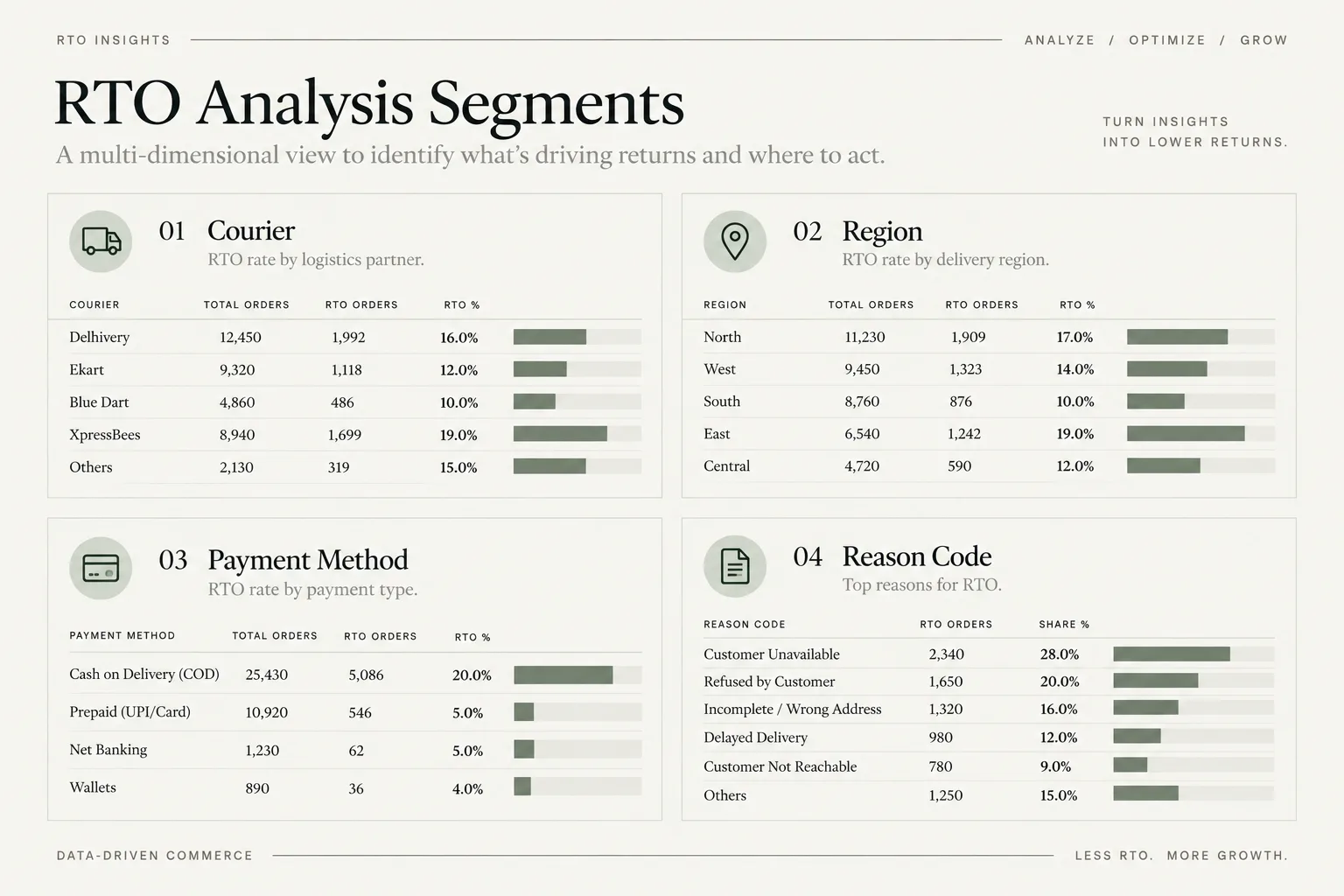
Six calculation mistakes that distort the result
- Using placed orders before outcomes settle. In-transit orders distort the denominator.
- Combining COD and prepaid rates. A blended rate hides different causes and remedies.
- Calling order value a loss. Revenue, contribution, inventory value, and direct cash cost are different measures.
- Ignoring reverse freight. The return leg can be as material as forward shipping.
- Assuming every RTO is preventable. Use a realistic target based on controllable segments.
- Celebrating a lower rate without checking delivery volume. Aggressive cancellation can improve the percentage while reducing good orders.
Frequently asked questions
What does RTO mean in ecommerce?
Return to origin means a parcel could not be delivered or was refused and is sent back to the seller or fulfilment centre. It normally occurs before a successful customer delivery.
How do you calculate direct RTO cost?
Multiply the number of RTO orders by forward freight, reverse freight, and packaging cost per returned order. Calculate COD and prepaid returns separately, then combine them for the total.
Should COD and prepaid RTO rates be combined?
No. Model them separately because their failure rates, customer behaviour, payment recovery, and interventions are usually different. A blended result is useful only after those segments are visible.
Is revenue at risk the same as an RTO loss?
No. Order value is revenue at risk, while the direct cost model covers freight and packaging. Product damage, handling, support, and delayed inventory can add further losses, while saleable returned stock may retain value.
How often should an RTO model be updated?
Update it after delivery outcomes settle for each reporting period. Review the result at least monthly, and more often when changing couriers, campaigns, confirmation rules, or payment incentives.
A first pass you can run this month
Pick one settled order cohort, then work through it in this order:
- Split the orders into COD and prepaid, and count RTO outcomes for each.
- Price each failure at forward freight plus reverse freight plus packaging.
- Put revenue at risk on its own line so nobody reads it as profit lost.
- Break the failures down by courier, region, SKU, channel, and reason code.
- Set a realistic target rate for the segments you can change, and test one intervention against it.
If the avoidable cost is small, a confirmation flow or prepaid incentive may not be worth the effort yet. If it is large and concentrated, you know where to start.
See the direct cost behind failed deliveries
Use the MlabsGrowth RTO Cost Calculator to model COD and prepaid RTO orders, revenue at risk, direct freight and packaging cost, and a target-rate saving scenario.
The calculator runs in your browser and works in the currency you choose. It does not connect to your store, so use settled data from one reporting period and validate the output against courier invoices.
Source notes
- Shopify Help Center, Manual payment methods, which covers enabling cash on delivery in Shopify, retrieved 2026-10-19.
- Razorpay, Cash on Delivery, a vendor estimate of COD and prepaid RTO rates in India, updated June 2026, retrieved 2026-10-19.
- U.S. Postal Service, Domestic Mail Manual 507, Mailer Services, which lists refused and failed-delivery endorsements for undeliverable mail, retrieved 2026-10-19.
- Shopify Help Center, Set up address collection preferences, which covers validating shipping addresses at checkout, retrieved 2026-10-19.
- The worked example uses illustrative inputs, not MlabsGrowth client results.
