Shopify return window overrides let merchants assign a different return period to a market, collection, product, or variant. Shopify released the feature on September 29, 2026, in time for holiday assortments that don’t fit one storewide rule.
The useful change isn’t simply a shorter window. It is a way to separate commercial rules without burying exceptions in support scripts. The safe rollout has three parts: decide which items truly need an exception, confirm the rule is lawful in each market, and make every customer-facing explanation match the Shopify setting.
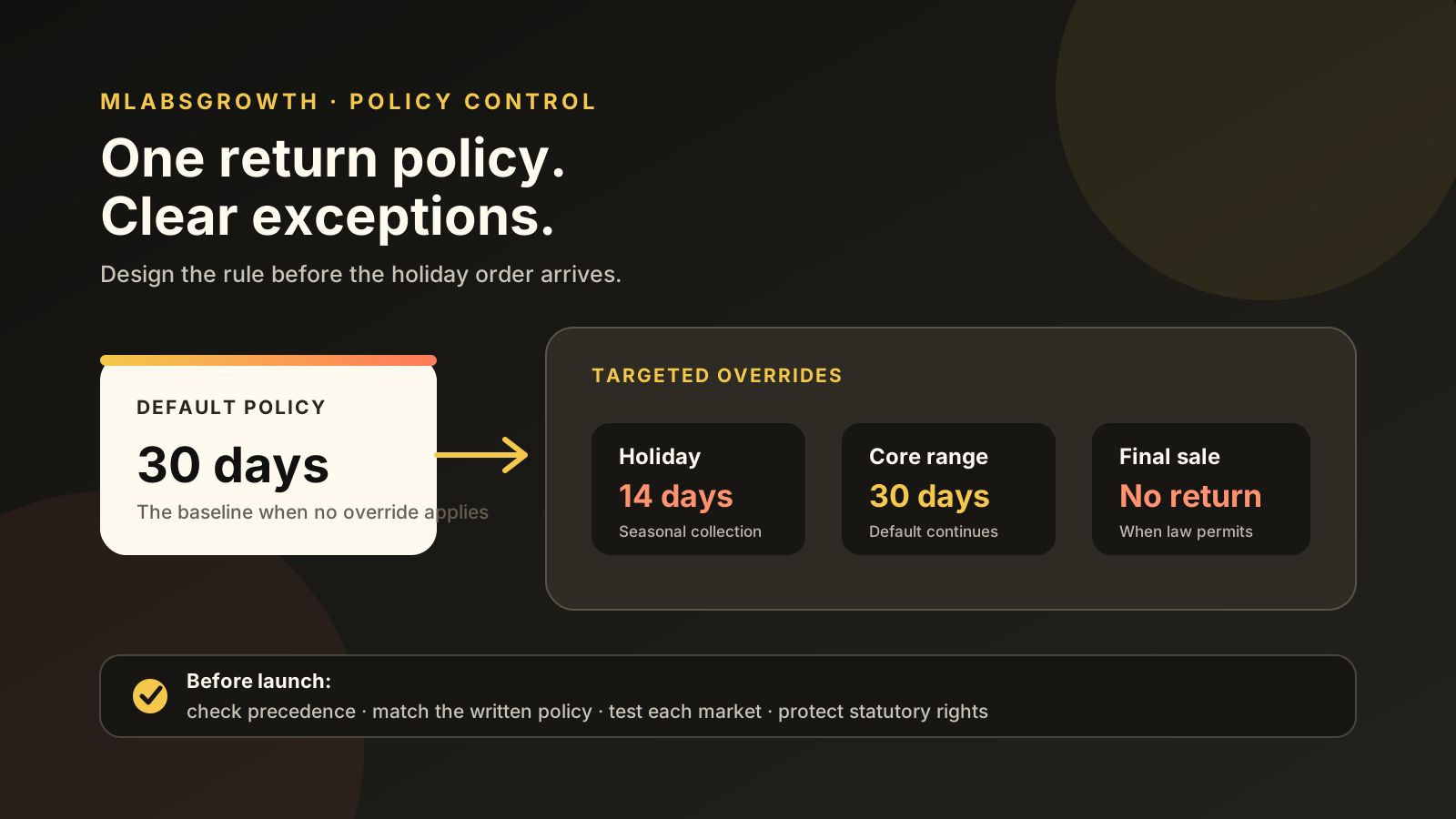
In short: overrides can target collections, products, or variants. When several match, the shortest window wins, and final sale takes priority over any override. Market-specific policies remain an early-access feature, and the configuration, written policy, and support answers must all agree.
Collection, product, and variant overrides
On September 29, 2026, Shopify’s return-window announcement added three targeting levels: collections, products, and variants. A selected item can now use a different return period from the default or market policy. Shopify’s example gives a holiday collection 14 days while the storewide default remains 90 days.
The controls sit under Settings → Policies → Return and cancellation rules. Shopify’s return-rules guide says a rule can also cover return shipping costs, restocking fees, final-sale items, and cancellations. An override changes the time window; it doesn’t replace those other decisions.
Structured settings and written policy are separate.
Shopify warns that its generated written policy does not automatically include the return rules configured in Admin. That means a correct backend rule can still create a poor customer experience if the policy page, product copy, and support macros say something else.
How do Shopify return rules resolve conflicts?
Shopify documents four decision layers. Final sale takes priority. If several overrides match, the shortest window wins. A market-specific policy replaces the default for that market, while the storewide default covers everything else. Mapping this order prevents an innocent collection overlap from silently shortening a customer’s deadline.
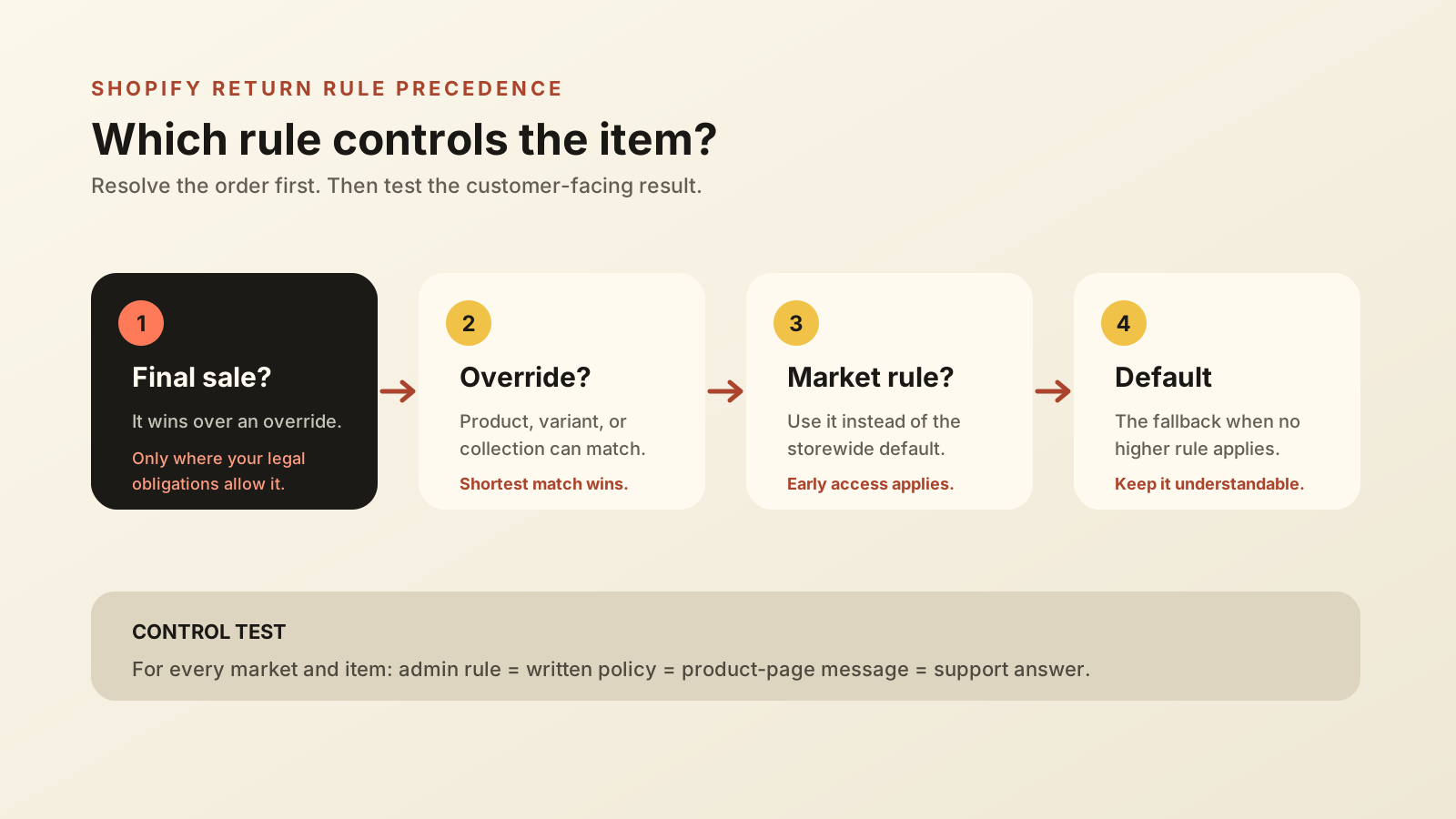
The overlap rule deserves attention. Suppose a gift set belongs to a 30-day gifting collection and a 14-day clearance collection. Shopify applies 14 days. Merchants should therefore audit automated collections, product tags, and merchandising feeds before creating a broad holiday exception. Final sale also needs careful language. Shopify blocks return and cancellation requests for products marked final sale, and says that status wins over an override. Yet a store policy cannot remove rights granted by law. The admin hierarchy answers which Shopify rule fires; it does not decide what local consumer law permits.
For the margin side, connect the expected return route to your D2C unit economics. A shorter window is not automatically more profitable if unclear terms increase support work, disputes, or unsellable late arrivals.
Which products need a return window override?
In 2025, the National Retail Federation’s Retail Returns Landscape estimated that 19.3% of online sales would be returned. That does not justify shortening every policy. It justifies separating products with materially different resale, seasonality, hygiene, customization, or reverse-logistics constraints.
Good override candidates have a clear operational reason:
- Seasonal products that lose most of their resale value after a fixed event.
- Personalized or made-to-order items that need a distinct eligibility decision.
- Fragile or high-value variants with a different inspection path.
- Clearance groups where the commercial policy is already different.
- Market-specific assortments that must reflect local terms.
Avoid an override when the real problem is inaccurate descriptions, weak sizing information, poor packaging, or inconsistent support. A tighter deadline will not repair those causes. Use your return reasons to fix the product page and fulfillment flow instead.
The holiday discount strategy can help separate a promotional price decision from a returns-policy decision. Sale pricing and return eligibility are related, but they are not the same control.
The cleanest rule set is usually the smallest one. Every extra exception creates another state that merchandising, customer support, warehouse staff, and the customer must interpret the same way.
A six-step launch before holiday orders
Shopify’s setup takes five Admin actions after selecting a rule, but a production launch needs six broader checks. The objective is not just to save the setting. It is to prove that an item receives the intended window, the customer sees accurate terms, and staff can explain the outcome without improvising.
1. Write the business reason
Name the inventory or service constraint behind the exception. “Holiday collection” is a label, not a reason. A strong note says the item loses seasonal resale value after a date, requires a special inspection, or follows a different market obligation.
2. Map the item scope
List the exact collection, product, or variants. Export or review any automated collection conditions. Highlight products that can enter more than one targeted group, because the shortest matching override will control them.
3. Check each market’s minimum rights
Ask local counsel or a qualified compliance adviser to review material restrictions. This article is operational guidance, not legal advice. Your voluntary store policy can be more generous than the minimum, but it cannot contract away rights that local law protects.
4. Configure the rule in Shopify
Open Settings → Policies, choose the return rule, add a return-window override, enter the days, and select the collection or products. Shopify allows multiple overrides. Market-specific return and cancellation policies are early access and available only to certain merchants.
5. Align every customer-facing surface
Update the written return policy, product-page notes, order emails, help centre, support macros, and campaign terms. Shopify says return-window information may appear on Shop product pages when the window is configured, while free-text-only policies do not supply that structured detail.
6. Test a rule matrix
Use one product per state: default, one override, overlapping overrides, final sale, and each active market. Record the expected and observed result. Recheck after collection rules, product tags, or market assignments change.
Pair the test with the landed-cost guide so returned freight, handling, duties, and recovery value are visible. A policy should follow the economics of the item, not hide them.
Return windows still have to meet local law
A Shopify override sets the window your store offers. Consumer law in each country sets the minimum it can offer, so check the rules for every market you ship to before shortening a window.
In the United States, the Federal Trade Commission’s online-shopping guidance tells shoppers to check the deadline, fees, and who pays return shipping; state rules can add requirements. GOV.UK’s returns guidance says online customers generally have a limited cancellation right and another 14 days to return after notifying the seller.
India’s official Consumer Protection (E-Commerce) Rules, 2020 require clear, accessible information about returns, refunds, exchanges, and return-shipping costs. Across markets, the operational lesson is the same: use Shopify’s market layer only after confirming the law and wording for that audience.
Before holiday volume arrives
Return window overrides make product-level policy easier to operate, but they also make hidden conflicts easier to create. Start with one justified exception, map the precedence, check market obligations, align every customer-facing message, and test real products before holiday volume arrives.
The order operations service shows where return operations fit beside conversion and automation work. Model the order-level effect with the website D2C profit calculator before treating a shorter window as a margin fix.
Turn the policy into an operating rule
MlabsGrowth can map return eligibility, support decisions, warehouse checks, and margin impact before a seasonal exception reaches live orders.
Frequently asked questions
What are Shopify return window overrides?
Return window overrides assign a different return period to selected collections, products, or variants instead of using only the default. Shopify also supports market policies for eligible early-access merchants. When several overrides match one item, the shortest matching window applies.
Can I set a shorter return window for holiday products?
Yes. Shopify’s announcement uses a 14-day holiday collection against a 90-day storewide default. The shorter period must still respect consumer rights in the buyer’s market, and the written policy should match the configured rule before the campaign starts.
What happens when two return overrides match?
Shopify applies the shortest matching window. A product in both a 30-day gift collection and a 14-day clearance collection receives the 14-day rule. Test products that sit in more than one collection before launch.
Does final sale override a return window?
Yes, Shopify says final sale takes priority over an override. Final sale cannot remove rights granted by applicable consumer law. Treat it as an operational setting that still needs a market-level legal and customer-communication review.
Source notes
- Shopify, “Return window overrides now available”, published September 29, 2026; retrieved October 18, 2026.
- Shopify Help Center, “Setting up return and cancellation rules”, retrieved October 18, 2026.
- National Retail Federation, “2025 Retail Returns Landscape”, published October 15, 2025; retrieved October 18, 2026.
- US Federal Trade Commission, “Online Shopping”, retrieved October 18, 2026.
- GOV.UK, “Accepting returns and giving refunds: the law”, retrieved October 18, 2026.
- Government of India, “Consumer Protection (E-Commerce) Rules, 2020”, published July 23, 2020; retrieved October 18, 2026.
