Cash on delivery still wins orders in markets where shoppers do not trust paying first. It also creates the most expensive failure in ecommerce: a parcel that travels to the customer, gets refused and travels back. In India that failure is called RTO (return to origin), and in the 2025 festive quarter it hit COD orders far harder than prepaid ones.
Unicommerce’s India D2C Report 2026 put festive-quarter RTO at 58% for COD orders and under 15% for prepaid orders. Most brands respond by hiring a calling team to confirm orders before dispatch. That works, but it does not scale into a sale day, and it only runs during office hours.
This guide shows how an AI voice agent and WhatsApp can confirm COD orders before they ship: WhatsApp first, an AI call for non-replies and risky orders, and fulfillment held until an answer arrives. It also covers how to connect the result to Shopify and which calling rules apply in India, the UAE and the US.
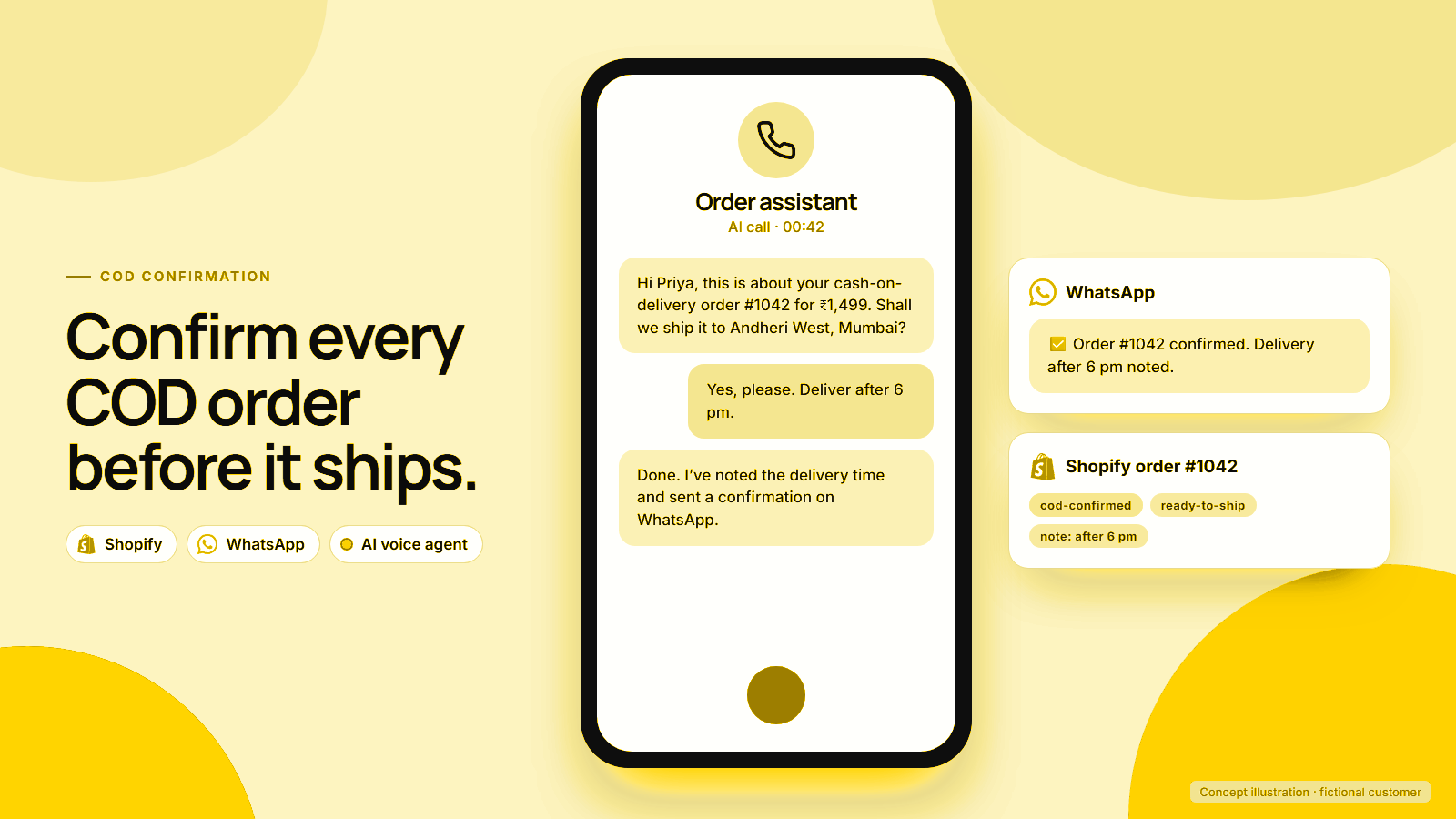
Platforms in this guide
 Shopify
 WhatsApp
Shopify Flow
AI voice agent
In this guide
- Why COD orders fail
- What AI confirmation calling is
- WhatsApp or voice
- The workflow, step by step
- Connecting it to Shopify
- Calling rules by country
- Measuring the result
- Mistakes to avoid
- The first week of rollout
- Frequently asked questions
Why do COD orders turn into RTO?
A COD order costs the customer nothing to place, so it carries no commitment. Unicommerce’s India D2C Report 2026, built on data from more than 6,000 brands, found COD orders returned at 58% in the festive quarter, while prepaid orders stayed under 15%. The gap is the price of zero commitment, and the same report shows it can be narrowed: RTO peaked at 39.2% in November 2025 and fell to 21.0% by March 2026 for brands Unicommerce describes as optimised.
Confirmation before dispatch is one of the cheapest levers in that optimisation. It acts before any freight is spent.
COD is not only an Indian question. Checkout.com’s MENA digital commerce report found COD preference across the region halved from 41% in 2020 to 20% in 2023, with cash preference as low as 10% in Saudi Arabia, the UAE and Kuwait. Fintech News Singapore, reporting on the Global Payments Report 2026, gives COD at 23% of ecommerce value in the Philippines and 16% in Vietnam.
Refused parcels usually come from a short list of causes:
- Impulse orders the customer no longer wants by delivery day.
- Wrong or incomplete addresses, especially missing landmarks.
- Duplicate orders placed twice by accident or to compare delivery times.
- Unreachable customers whose phone is off when the courier calls.
- Fake or prank orders, which a store with no payment step cannot filter.
Each of these can be found with one question asked before dispatch: do you still want this order, at this address? To put a figure on your own losses, use the RTO cost calculator or the step-by-step RTO cost guide.
What an AI confirmation call does
AI COD confirmation calling is an automated phone call placed soon after a cash on delivery order. A voice agent reads the order details, asks the customer to confirm, correct the address or cancel, and writes the answer back to the store. Orders that are not confirmed are held rather than shipped, so the refusal happens on the phone instead of at the doorstep.
A human calling team does the same job; the difference is capacity and timing. A team of three can make a few hundred calls a day during office hours. An AI agent can call every COD order within minutes of checkout, in the customer’s language, and repeat the attempt at a set interval without anyone watching a queue.
A good confirmation call is short and predictable:
- Greet the customer by name and name the brand.
- Read the order number, items, total amount and delivery area.
- Ask one question: confirm, change the address, or cancel.
- Offer a prepaid payment link if the store runs a prepaid incentive.
- Confirm the outcome back and send a WhatsApp or SMS summary.
It should not sell. Upselling during a confirmation call turns a service call into a promotional one, which changes the legal rules in several countries and annoys a customer who only wanted to confirm.
Should you confirm on WhatsApp or by phone?
Use WhatsApp first and a voice call second. A WhatsApp utility template is inexpensive, easy to answer with one tap and leaves a written record. Meta’s WhatsApp pricing page says utility templates sent inside an open customer service window are free. A call then goes only to the customers who do not reply.
| Channel | Best for | Watch out for |
|---|---|---|
| WhatsApp utility template | Every COD order; one-tap confirm, change address or pay online | Needs opt-in; template must be approved as utility, not marketing |
| AI voice call | No reply after a set time, high-value or high-risk orders, customers who prefer calls | Calling hours, language and accent quality, local call rules |
| Human call | Unreachable after AI attempts, angry customers, disputes | Cost and capacity during sale peaks |
| SMS | Customers without WhatsApp, fallback confirmation | Lower reply rates; sender registration rules in India |
Meta’s opt-in guidance says consent does not have to be WhatsApp-specific but must name the business and comply with local law. A checkbox at checkout that says the customer agrees to receive order updates from your brand on WhatsApp covers most stores. Since 1 July 2025, Meta charges per delivered template message, so keep confirmation templates short and send them once.
The workflow, from new order to dispatch
A working workflow has five stages: score the order, message on WhatsApp, call when needed, write the answer back and act on it before dispatch. The logic is the same whether the store ships 50 or 5,000 COD orders a day; only the risk rules and calling capacity change.
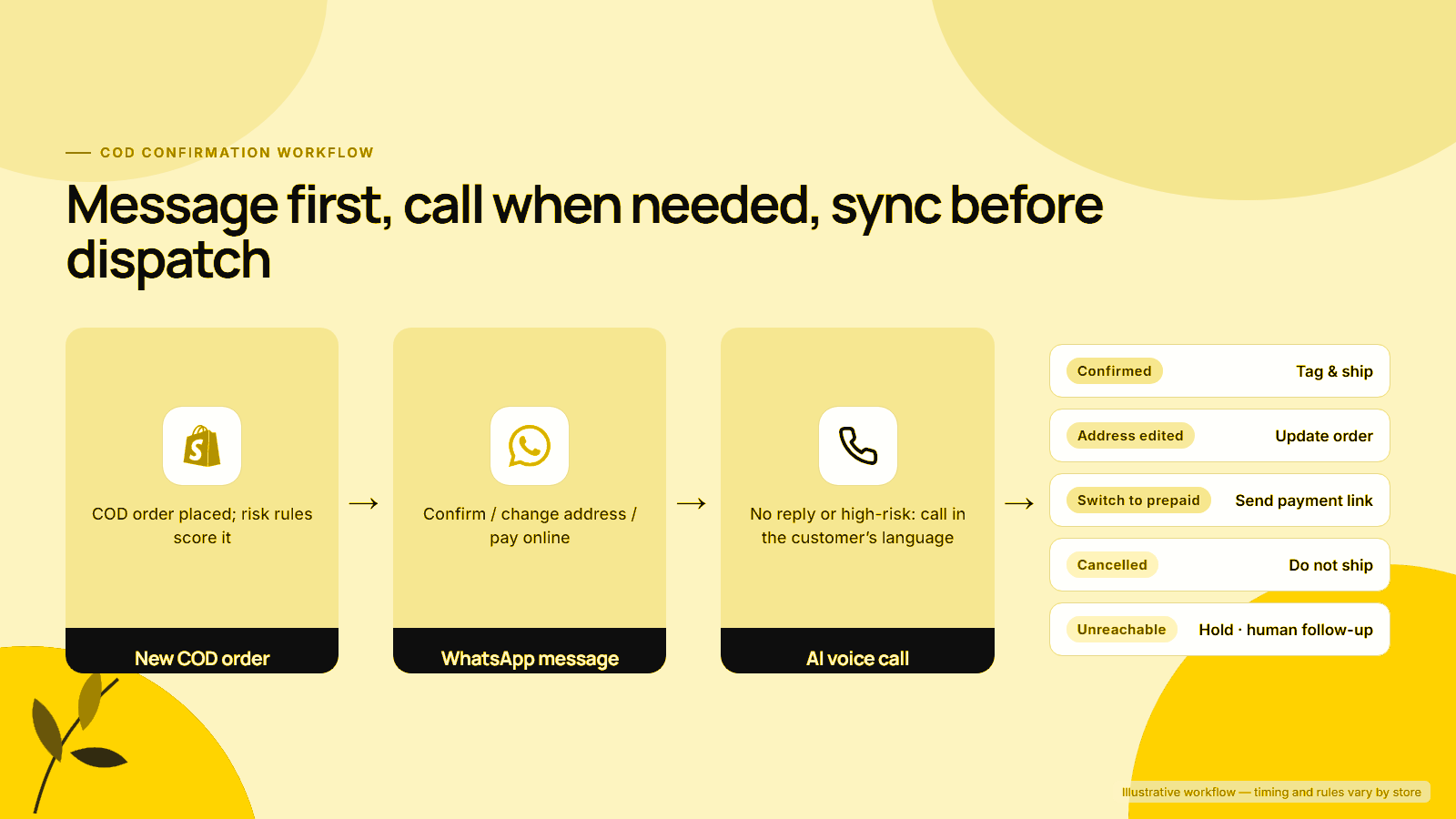
- Score the order. Flag orders with a high cart value, an incomplete pincode or address, a first-time phone number, or several orders from the same number in a day.
- Send a WhatsApp confirmation. Include the order number, amount, address and three buttons: confirm, change address, cancel. Add a prepaid link if you offer a prepaid discount.
- Call non-replies and risky orders. Wait a set time, for example two hours in business hours, then place an AI call in the customer’s language. Retry once at a different time of day.
- Write the outcome back. Tag the order: confirmed, address updated, switched to prepaid, cancelled or unreachable. Store the call transcript or recording where your team can see it.
- Act before dispatch. Release confirmed orders to the warehouse, cancel refused ones, and send unreachable orders to a person for one last attempt.
Set the cut-off by courier pickup, not by the clock. If the courier collects at 4pm, the last confirmation attempt should finish by 3pm. An order confirmed at 5pm ships a day late, and a late order is itself an RTO risk.
Wiring the result into Shopify
Shopify records COD as a manual payment method, and its manual payments documentation says these orders stay unpaid until the merchant marks them paid after collecting cash.
That gives you a clean trigger. Every new order with a COD payment method enters the confirmation workflow.
The Shopify pieces you need are all native:
- Hold fulfillment. Shopify’s holding fulfillments guide lets you add up to 10 manual holds to a fulfillment. The status changes to “On hold” and returns to “Unfulfilled” when holds are released.
- Automate with Flow. The Shopify Flow action Hold fulfillment order takes a reason and notes. Flow is available on the Basic, Grow, Advanced and Plus plans, per Shopify’s Flow overview.
- Tag outcomes. The calling or WhatsApp tool writes tags such as
cod-confirmedorcod-cancelled. Flow watches for the tag and releases the hold, cancels the order or alerts a person.
Shopify’s own fraud analysis gives recommendations for eligible online credit card orders. It is not designed to judge whether a COD customer will accept a parcel, so your own risk rules and the confirmation result do that job.
| Order tag | Flow action | Warehouse sees |
|---|---|---|
cod-confirmed |
Release hold | Ready to pack |
cod-address-updated |
Update address, then release hold | Ready to pack, new address |
cod-prepaid |
Mark paid when payment clears, release hold | Ready to pack |
cod-cancelled |
Cancel order, restock | Nothing |
cod-unreachable |
Keep hold, notify a team member | On hold |
Shopify notes that other apps can overwrite order tags, so test the flow with your shipping and COD apps installed. Our order operations service builds this setup in the merchant’s own Shopify and WhatsApp accounts.
What rules apply to automated confirmation calls?
A confirmation call is transactional, but automated calling is regulated almost everywhere COD is common. In India, TRAI and the DPDP Rules apply. The UAE restricts marketing calls to 9am to 6pm. In the US, AI-generated voices count as artificial under the TCPA. Keep calls strictly about the order, and take local legal advice before launch.
India: TRAI and DPDP
TRAI’s Telecom Commercial Communications Customer Preference (Second Amendment) Regulations, 2025, dated 12 February 2025, separates promotional calls from service and transactional calls and assigns each its own number series. Use the series your telecom provider assigns for service calls, and never mix an offer into a confirmation call. Trade press reported a further amendment on automated calls in September 2026, so check TRAI’s final notified text before launch.
India’s Digital Personal Data Protection Rules were notified in November 2025. The government’s explainer describes an 18-month phased compliance period and requires a separate consent notice with a specific purpose. In practice: tell customers at checkout that you will contact them by phone or WhatsApp to confirm the order, and use the number only for that purpose unless they agree to more.
UAE and the Gulf
UAE Cabinet Resolutions 56 and 57 of 2024 restrict telemarketing calls to 9am to 6pm, require licensed local numbers and set fines up to AED 150,000, as summarised by Trench & Associates. The rules are aimed at marketing calls. Whether an order confirmation the customer expects is covered is not settled, so the safe practice is to call within the same hours and never pitch.
United States
In February 2024, the FCC ruled that AI-generated voices are “artificial” under the Telephone Consumer Protection Act. Automated calls need the customer’s prior express consent, and telemarketing calls need prior written consent. COD is rare in the US, but the same rule covers any AI delivery or confirmation call.
Measure delivered orders, not confirmations
Measure delivered orders and RTO rate, not confirmation rate. A workflow that confirms 90% of orders means nothing if the confirmed orders still get refused.
Compare RTO for confirmed orders against a hold-out group that skips confirmation, over at least two weeks, and track the cost of every call and message.
Track these weekly:
| Metric | Why it matters |
|---|---|
| RTO rate, confirmed vs hold-out | The only proof the workflow works |
| Share cancelled before dispatch | Freight you did not spend |
| Share switched to prepaid | Orders with no RTO risk left |
| Unreachable share | Tells you if call timing or language is wrong |
| Cost per confirmed order | Calls, messages and human follow-up combined |
| Delivered-order contribution | Profit after RTO, freight and confirmation cost |
GoKwik’s Smart COD product page claims its tools can cut RTO by 40%. That is a vendor figure, not an independent study, and your hold-out test is the number that matters. Feed the result into the unit economics calculator to see what delivered orders earn after confirmation costs. The RTO cost guide explains how to split COD and prepaid returns in that model.
Six ways confirmation projects fail
Most confirmation projects fail on operations, not on the AI. The call works, but nobody acts on the result, or the result arrives after the courier has collected the parcel. Build the hold-and-release logic first, then add the voice agent.
- Shipping before the answer arrives. If fulfillment is not held, confirmation is only a courtesy call.
- Calling at the wrong time. Evening calls get answered more often in some markets, but they must stay within legal hours.
- One language for everyone. Match the call language to the customer’s region or checkout language.
- Selling on the call. A confirmation call that pitches becomes a promotional call.
- No human fallback. Unreachable and angry customers need a person, not a third robot call.
- Blocking good customers. Repeat customers with clean delivery history can skip the call.
For peak season, run the workflow for at least a month before your biggest sale. Our BFCM 2026 profit checklist covers the operational cut-offs, and 7 AI marketing workflows for small teams shows where COD triage fits alongside other automations.
The first week of rollout
COD will keep winning orders where shoppers prefer to pay at the door, and most of the RTO cost is decided before the parcel leaves the warehouse. A WhatsApp message and an AI call move that decision to the cheapest moment, the first hours after checkout. Set it up in the first week:
- Add the consent line at checkout. Tell customers you will contact them by phone or WhatsApp to confirm the order, and use the number only for that purpose.
- Build the hold first. Set Shopify Flow to hold every new COD order and to release, cancel or escalate it on the outcome tags. Test it with your shipping and COD apps installed.
- Get the WhatsApp template approved as utility. Order number, amount, address and three buttons: confirm, change address, cancel.
- Switch on the AI call for non-replies and risky orders. Keep it about the order, stay inside legal calling hours and finish the last attempt before courier pickup.
- Split off a hold-out group and start the weekly table. The RTO comparison needs at least two weeks of orders before it means anything.
From then on, judge the workflow by delivered-order profit against the hold-out, not by how many customers said yes.
Confirm every COD order before it ships
MlabsGrowth builds COD confirmation workflows with WhatsApp, AI calling and Shopify Flow, inside your own accounts, then measures the RTO change against a hold-out group.
Explore COD confirmation and order automation or book a 30-minute call.
Frequently asked questions
What is AI COD confirmation calling?
It is an automated voice call placed shortly after a cash on delivery order. An AI agent reads the order, asks the customer to confirm, change the address or cancel, and writes the answer back to the store as an order tag or note. Unconfirmed orders are held instead of shipped.
Does calling customers reduce RTO?
Confirmation removes orders the customer never intended to accept before they cost freight. Unicommerce’s India D2C Report 2026 found festive-quarter COD returns of 58% against under 15% for prepaid, and RTO falling from 39.2% to 21.0% for optimised brands. No independent study isolates the effect of calls alone, so measure it with a hold-out group.
Should I use WhatsApp or a voice call to confirm COD orders?
Use both in sequence. A WhatsApp utility template is cheap and easy to answer, and Meta does not charge for utility templates sent inside an open customer service window. Call only the customers who do not reply or whose orders look risky, so voice minutes are spent where they change the outcome.
Is it legal to use AI voice calls for order confirmation?
Usually, if the call is transactional, the customer gave their number for the order and you follow local rules. In India, TRAI’s framework separates promotional and service calls and DPDP Rules require purpose-specific consent. The UAE limits marketing calls to 9am to 6pm. In the US, the FCC treats AI voices as artificial under the TCPA. Take local legal advice.
How do I connect AI confirmation calls to Shopify?
Trigger the workflow when a COD order is created, hold its fulfillment, and let the calling tool write back a result tag such as cod-confirmed or cod-cancelled. Shopify Flow can then release the hold, cancel the order or alert a person. Shopify lets you add up to 10 manual holds to a fulfillment.
Source notes
- Unicommerce, India D2C Report 2026, published April 2026, retrieved 2026-09-24.
- Checkout.com, MENA report finds cash on delivery usage halved, published 2024-05-14, retrieved 2026-09-24.
- Fintech News Singapore, Southeast Asia payment methods: Global Payments Report 2026, published 2026-04-03, retrieved 2026-09-24.
- Telecom Regulatory Authority of India, TCCCPR (Second Amendment) Regulations, 2025, dated 2025-02-12, retrieved 2026-09-24.
- Press Information Bureau, Digital Personal Data Protection Rules, 2025, published 2025-11-17, retrieved 2026-09-24.
- Trench & Associates, New telemarketing rules in the UAE, published 2024-06-09, retrieved 2026-09-24.
- US Federal Communications Commission, FCC makes AI-generated voices in robocalls illegal, published 2024-02-08, retrieved 2026-09-24.
- Meta for Developers, WhatsApp Business Platform pricing, retrieved 2026-09-24.
- Meta for Developers, Get opt-in for WhatsApp, retrieved 2026-09-24.
- Shopify Help Center, Manual payment methods, retrieved 2026-09-24.
- Shopify Help Center, Holding fulfillments, retrieved 2026-09-24.
- Shopify Help Center, Hold fulfillment order action in Shopify Flow, retrieved 2026-09-24.
- Shopify Help Center, Shopify Flow, retrieved 2026-09-24.
- Shopify Help Center, Fraud analysis, retrieved 2026-09-24.
- GoKwik, Smart COD Suite (vendor claim), retrieved 2026-09-24.