The 2026 holiday shipping deadline on a carrier website is not your store’s safe customer order-by date. A carrier cutoff begins after an order is packed and handed over. Your storefront promise must also cover fulfillment time, weekends, stock exceptions, address corrections, and the risk that peak-season capacity slips.
The timing is live now. On October 4, USPS changed prices for four package services through January 17, 2027. On September 22, it published recommended dates for delivery before December 25. For D2C teams, the useful question is not “What is the last carrier date?” It is “What date can we defend at checkout without giving away the margin?”
That makes the shipping promise part of the wider growth and operations system, not a carrier-calendar task.
Key takeaways
- USPS peak pricing applies to four package services from October 4, 2026 through January 17, 2027.
- For the contiguous US, USPS recommends December 17, 18, or 19 depending on the service.
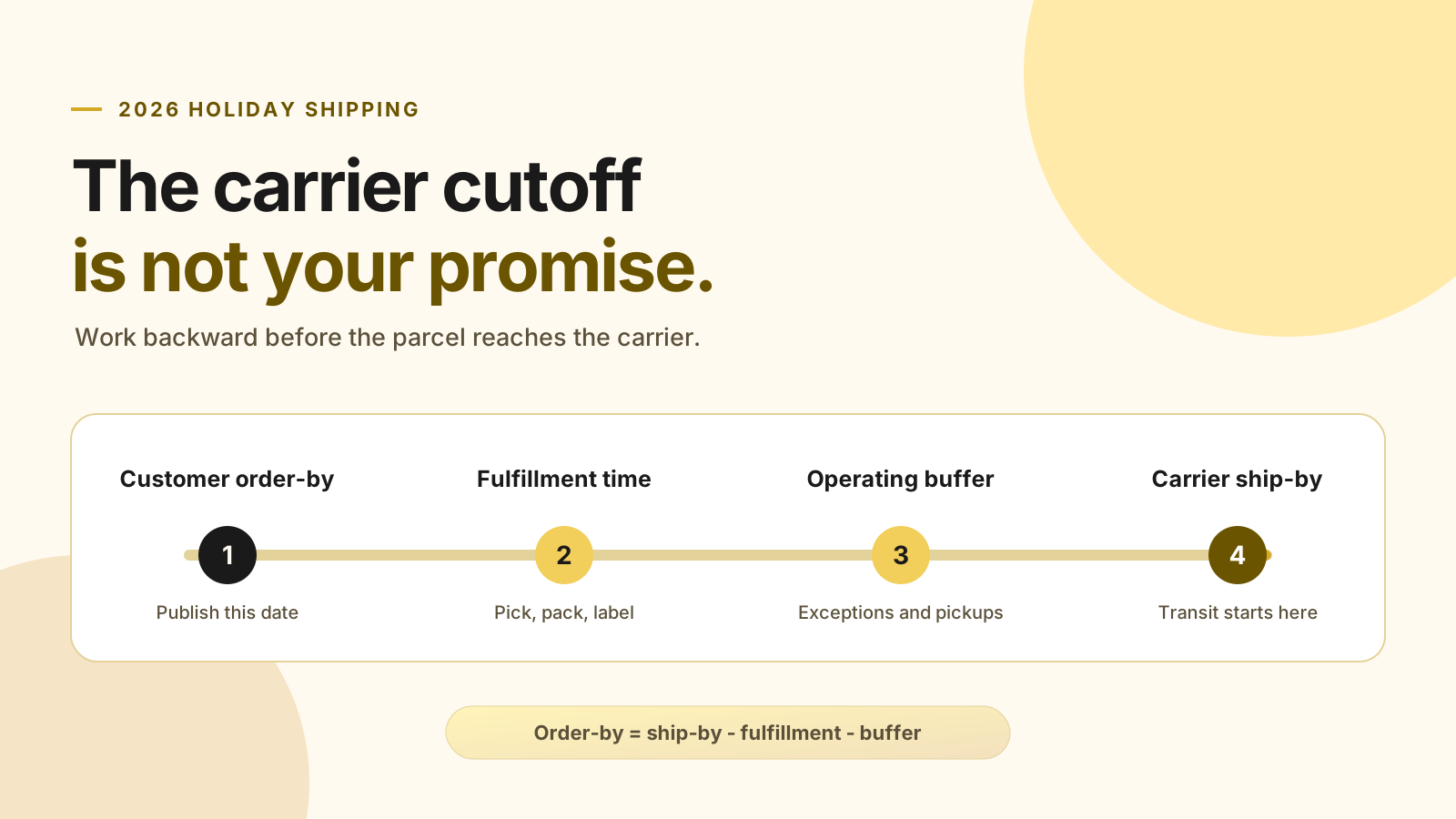
- A safe customer order-by date subtracts fulfillment time and an operating buffer from the carrier cutoff.
- Recheck contribution after shipping before keeping a free-delivery threshold unchanged.
Why is a carrier deadline not your customer order-by date?
USPS published four recommended 2026 dates for delivery before December 25, ranging from December 17 to December 19. Those dates assume the parcel is already with USPS. A store must work backward from them, because payment review, picking, packing, label creation, and carrier handoff all happen before transit begins.
The distinction is easy to miss. Shopify’s fulfillment-time documentation says checkout delivery dates combine fulfillment time with transit time. It also uses fulfillment time to calculate an order’s fulfill-by date. A “2-day service” is not a two-day customer promise when your warehouse needs another two days.
For expected delivery before December 25 in the contiguous US, USPS’s 2026 Holiday Mailing and Shipping Dates, published September 22, lists:
| USPS service | Recommended ship-by date | What the store must add before it |
|---|---|---|
| Ground Advantage | December 17 | Fulfillment time plus operating buffer |
| First-Class Mail | December 17 | Fulfillment time plus operating buffer |
| Priority Mail | December 18 | Fulfillment time plus operating buffer |
| Priority Mail Express | December 19 | Fulfillment time plus operating buffer |
These are recommendations, not a merchant guarantee, and USPS tells customers to ship early. Stores should publish an earlier order-by date and keep a later express window only where the service, destination, stock, and warehouse schedule support it.
What the 2026 price changes do to margin
On October 4, 2026, USPS implemented temporary price changes across four services: Priority Mail Express, Priority Mail, Ground Advantage, and Parcel Select. The changes run until January 17, 2027. Exact charges vary by service and shipment, so use the current rate table or your label data rather than a single average surcharge.
That window covers the full US holiday peak and the January returns period. If a store absorbs shipping, every label change reduces contribution; if the customer pays, a higher checkout charge can affect conversion.
Either way, the old free-shipping threshold deserves another look.
Use this margin check for each high-volume package profile:
- Export the current label cost by service, zone, weight, and package.
- Compare it with the same profile before October 4.
- Add packaging, pick-and-pack, reshipment, and expected return or RTO cost.
- Recalculate contribution after shipping for full-price, discounted, and free-shipping orders.
- Change the threshold only when the new number protects both conversion and contribution.
An illustrative $80 order with $24 of contribution before shipping has a 30% contribution margin. If the store’s shipping subsidy rises by $2.50, contribution falls to $21.50, a 10.4% reduction. That example is arithmetic, not a benchmark. Use the unit economics calculator with your own product and delivery costs.
Our holiday discount strategy explains how to set a discount ceiling. Combine that ceiling with the shipping subsidy, because a promotion that survives either cost alone can still lose money when both land on the same order.
How do you calculate a safe holiday order-by date?
Start with one carrier ship-by date, then subtract two store-controlled inputs: actual fulfillment time and a peak operating buffer. If Ground Advantage must ship by Thursday, December 17, two business days of fulfillment moves the cutoff to Tuesday, December 15. One more business day of buffer moves it to Monday, December 14.
Customer order-by date = carrier ship-by date - fulfillment time - operating buffer
The buffer should cover the failures your normal transit estimate omits:
- Weekend and holiday warehouse closures
- Inventory mismatches or split shipments
- COD or fraud confirmation holds
- Invalid addresses and customer corrections
- Carrier collection limits or missed scans
- Remote postcodes, PIN codes, islands, and territories
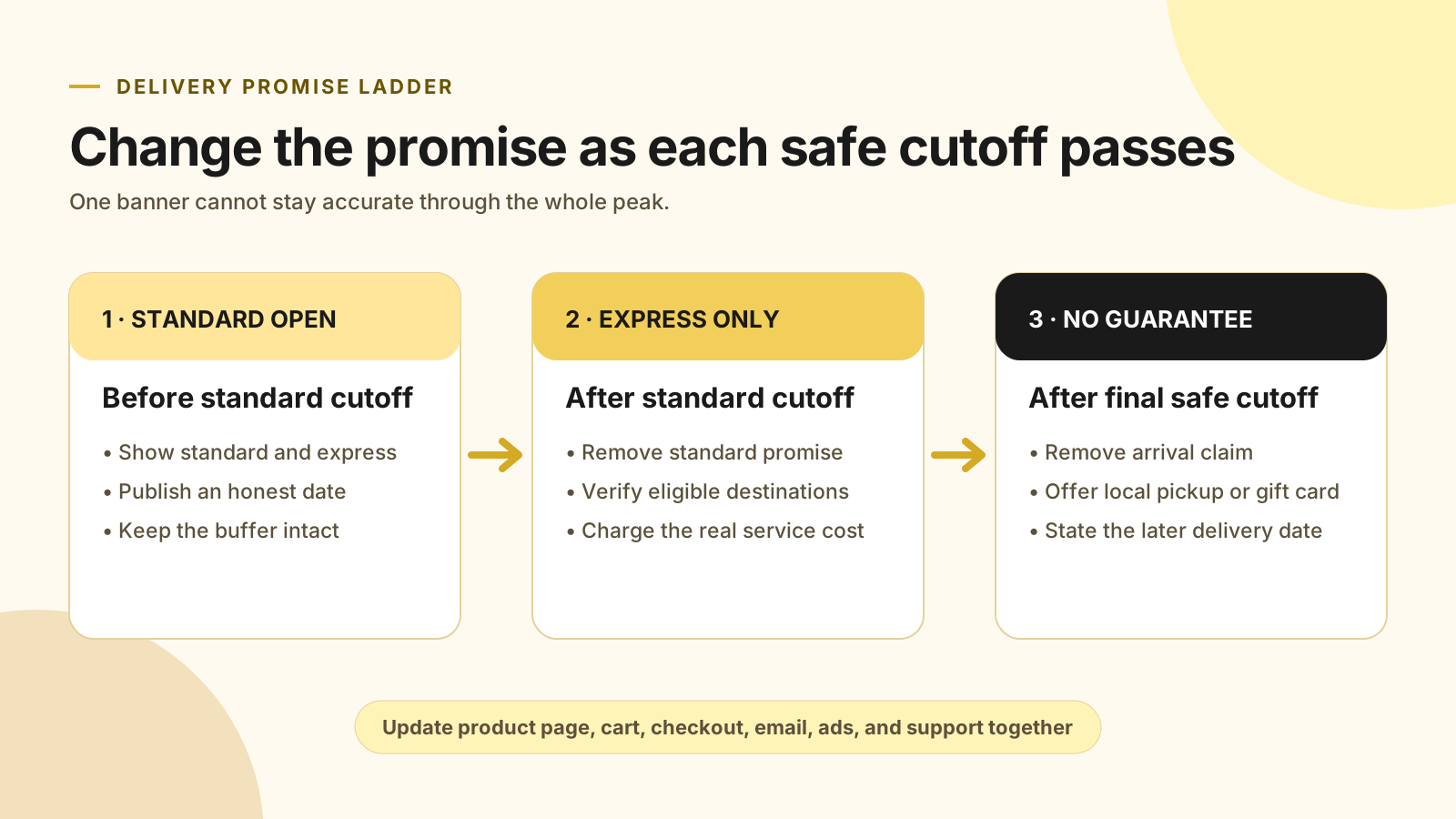
Set three storefront phases, not one permanent banner. Keep standard delivery open until its safe cutoff. Then show only express services that can still meet the date. Finally, remove the arrival promise and offer local pickup, a digital gift card, or a clearly dated post-holiday delivery.
Do not hide the transition in a policy page. Update the product page, cart, checkout rate names, confirmation email, support macros, and campaign copy together, so a customer sees the same promise from ad to order confirmation.
What should US, UK, and India teams do differently?
Two current signals show why one global cutoff is unsafe. USPS lists service-specific US dates between December 17 and 19. In India, Amazon reported more than 2 times the seller units in the first 24 hours of its 2026 Great Indian Festival versus the same period last year. Each market needs its own carrier evidence and operating buffer.
United States: map the official dates to each shipping profile
Use the September 22 USPS dates as the starting point, then model your own handling time. Check Alaska, Hawaii, Puerto Rico, US territories, military, and international destinations separately. The contiguous-US table does not cover them all.
UPS has a different operating calendar. Its 2026 holiday schedule says December 24 air and international-air pickup must be arranged by December 18, while Ground pickup is unavailable that day. Do not merge carrier calendars into one generic “express” rule.
United Kingdom: wait for a verified 2026 carrier table
Use Royal Mail, Post Office, DPD, Evri, or your contracted carrier’s current business guidance when it names 2026. Do not copy a consumer-facing table merely because the page footer says 2026. Day-and-date pairs can reveal stale schedules. Publish the store cutoff only after the carrier year, service, postcode coverage, and collection arrangement all agree.
India: plan around serviceability, COD, and NDR follow-up
Amazon’s October 9 update is platform-reported data, not a market-wide benchmark. It still shows why peak capacity should be planned before the ad spike: sellers recorded more than 2 times the units in the first 24 hours year over year, and orders came from every PIN code.
For an Indian D2C store, build cutoffs by courier serviceability and recent lane-level delivery time. Keep COD confirmation and failed-delivery follow-up inside the plan. The AI calling guide for COD orders covers confirmation before dispatch, while the RTO cost guide separates revenue at risk from direct logistics cost.
Putting the deadlines into Shopify
Shopify documents four fulfillment-time choices: same business day, next business day, two business days, or a custom range. Those settings feed checkout delivery dates and fulfill-by dates.
Holiday promises therefore need an operational configuration change, not just a homepage banner or a note in the shipping policy.
Use this seven-point release checklist:
- Separate markets and zones. Confirm every destination sits in the correct active market and shipping zone.
- Update fulfillment time. Use peak handling time, not the fastest week from summer.
- Verify weights and packages. Shopify says carrier-calculated rates use weight, dimensions, destination, and requested speed.
- Name rates clearly. “Standard” is vague. Add an honest transit range or arrival date where the setup supports it.
- Cover rate failures. Shopify’s backup rates can keep checkout open when every eligible app or carrier rate fails. Check the fallback amount before peak traffic.
- Run real test orders. Test representative products, discounts, bundles, postcodes, PIN codes, and payment methods on mobile and desktop.
- Schedule the promise changes. Assign an owner and time for standard cutoff, express cutoff, and removal of the final guarantee.
The BFCM 2026 profit checklist covers stock, offers, ads, and returns around the same period. Keep the shipping release checklist separate so one person owns each date and checkout change.
Metrics that show whether the promise holds
Track four measures by order date and destination: on-time delivery, shipping cost per delivered order, delivery-related contact rate, and contribution after shipping. A carrier’s transit score alone misses orders packed late. A cheap label alone misses refunds and customer recovery work. Review the full delivered-order outcome.
Start with these definitions:
| Metric | Practical calculation | What it catches |
|---|---|---|
| On-time delivery rate | Orders delivered by promised date / eligible delivered orders | Promise accuracy |
| Shipping cost per delivered order | Label, packaging, reshipment, and return cost / delivered orders | True fulfillment cost |
| Delivery contact rate | Delivery-related tickets / dispatched orders | Support burden |
| Contribution after shipping | Net sales minus variable costs, shipping subsidy, and returns | Profit impact |
Compare orders placed before and after each cutoff change. Split COD and prepaid where both exist, and split regions with different carrier performance too. One blended store average can hide the route that breaks the promise.
Write the stop rule before the last shipping week. If on-time delivery falls below your own acceptable baseline on a lane, remove its arrival promise or switch the offered service. The purpose is not to rescue every possible late order. It is to stop a local failure from becoming a store-wide claim.
Turn the carrier calendar into an order workflow
MlabsGrowth can map one holiday order flow across confirmation, fulfillment, delivery exceptions, and owner handoffs.
Frequently asked questions
What are the USPS holiday shipping deadlines for 2026?
For expected delivery before December 25 in the contiguous United States, USPS recommends December 17 for Ground Advantage and First-Class Mail, December 18 for Priority Mail, and December 19 for Priority Mail Express. These are carrier ship-by dates, not safe customer order-by dates for an ecommerce store.
When did USPS holiday price changes start in 2026?
USPS temporary holiday price changes started on October 4, 2026 and remain in effect until January 17, 2027. They affect four package services: Priority Mail Express, Priority Mail, USPS Ground Advantage, and Parcel Select. The exact change depends on the service and shipment details.
How do I calculate a holiday order-by date?
Start with the carrier’s recommended ship-by date. Subtract your real fulfillment time, then subtract an operating buffer for weekends, stock exceptions, address corrections, and missed pickups. For example, a December 17 carrier cutoff with two business days for fulfillment and one buffer day produces a December 14 customer cutoff.
Should I promise Christmas delivery after the carrier cutoff?
No. After the standard-service cutoff, switch to an eligible express option with a clear price and date. When no service supports a defensible arrival date, remove the promise. Offer local pickup, a digital gift card, or delivery after December 25 instead of presenting hope as a guarantee.
How should Indian D2C brands plan festive delivery deadlines?
Use courier serviceability and recent lane-level delivery data, not USPS or UK dates. Amazon reported more than 2 times the seller units in the first 24 hours of its 2026 Great Indian Festival versus the prior year. Build extra capacity for confirmation, packing, handoff, NDR follow-up, and COD exceptions.
Set your order-by dates, lane by lane
The last carrier date is an input, not a promise. USPS has already changed four peak-season package prices, and the major December cutoffs are close, so set the decision dates now:
- Pick the carrier ship-by date for each service and destination. For the contiguous US, USPS recommends December 17, 18, or 19 depending on the service; check UPS, other carriers and non-contiguous destinations separately.
- Subtract real fulfillment time, using peak handling time rather than the fastest week from summer.
- Subtract an operating buffer for weekends, stock exceptions, address corrections, and missed pickups.
- Recheck contribution after shipping against the October 4 rate change before keeping free shipping or a late express option.
- Schedule the three phases (standard cutoff, express-only, and removal of the arrival guarantee) and give each change an owner.
- Publish the earlier customer cutoff on every buying surface, and write the stop rule before the last shipping week.
Keep the promise that operations can actually deliver.
Source notes
- USPS Employee News, Temporary price changes for holiday season take effect, published 2026-10-04, retrieved 2026-10-11.
- USPS Newsroom, Postal Service Recommends 2026 Holiday Mailing and Shipping Dates, published 2026-09-22, retrieved 2026-10-11.
- UPS, 2026 UPS Holiday Schedule, retrieved 2026-10-11.
- Shopify Help Center, Getting started with fulfillment time and delivery dates, retrieved 2026-10-11.
- Shopify Help Center, Setting up shipping zones and rates, retrieved 2026-10-11.
- Shopify Help Center, Backup shipping rates, retrieved 2026-10-11.
- Amazon India, Amazon Great Indian Festival 2026 records historic opening with 100% YoY growth on shopping volume, updated 2026-10-09, retrieved 2026-10-11.
