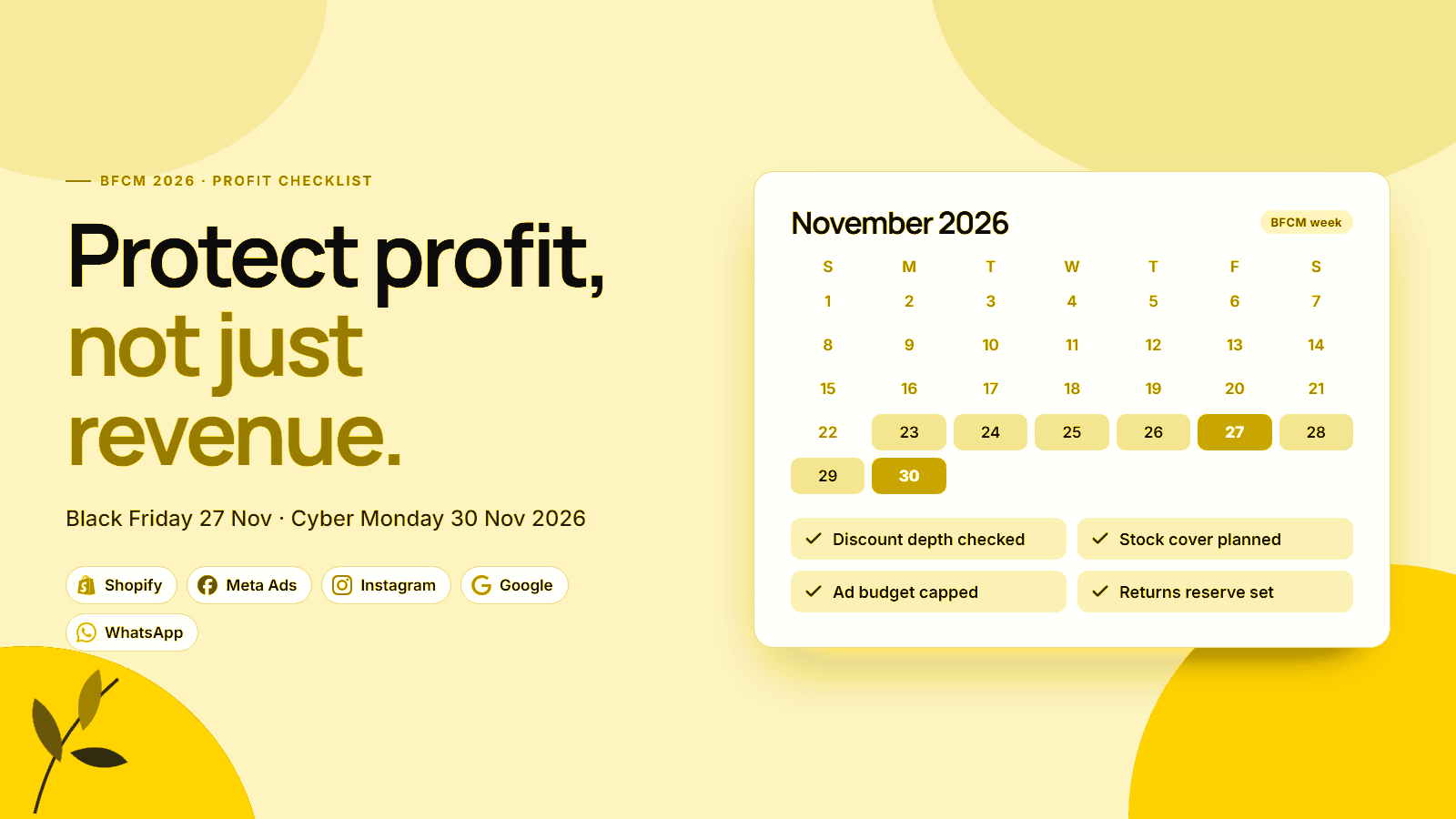
A profitable BFCM 2026 plan starts with contribution margin, not sales targets. Black Friday falls on 27 November 2026 and Cyber Monday on 30 November, so a store has about nine weeks to set discount limits, place stock orders, prepare ads and checkout, and reserve cash for December returns.
Most Black Friday advice focuses on selling more, but revenue is the easy number to grow. A 30% sitewide discount, expensive peak-week traffic and a wave of cash-on-delivery refusals can produce a record sales day and a weaker month. Stock and ad decisions need to be made in October, and cash for returns, RTO and supplier payments should be set aside before any BFCM revenue is treated as profit.
This checklist runs week by week from October planning to December returns. It shows the discount maths, where bundles beat flat discounts, how to order stock against lead times, and what to watch once the sale is live.
Platforms in this guide
 Shopify
 Meta Ads
 Instagram
 Google
 WhatsApp
In this guide
- Key BFCM 2026 dates
- Why profit comes first
- Your discount ceiling
- Bundles versus flat discounts
- The week-by-week checklist
- Inventory and lead times
- Ad budget and rising auction costs
- Site speed and checkout readiness
- COD and RTO risk
- AI shopping assistants
- December returns and cash
- Frequently asked questions
When are Black Friday and Cyber Monday 2026?
US Thanksgiving falls on Thursday 26 November 2026, so Black Friday is Friday 27 November and Cyber Monday is Monday 30 November. Adobe defines Cyber Week as the five days from Thanksgiving to Cyber Monday, which in 2026 runs from 26 to 30 November.
In practice the selling window is wider: many brands open early access a week or two before and extend offers into early December. It is also large. According to Adobe’s 2025 holiday season recap, US shoppers spent $257.8 billion online between 1 November and 31 December 2025, with $11.8 billion on Black Friday and $14.25 billion on Cyber Monday. Shopify reported that its merchants sold $14.6 billion over the 2025 BFCM weekend, up 27% year on year.
For 2026, Deloitte’s holiday retail forecast, released on 10 September, expects US e-commerce holiday sales of $316.1 billion to $318.9 billion from November 2026 to January 2027, growth of 7.5% to 8.4%. Adobe and Salesforce usually publish their final holiday forecasts in the autumn; as of 24 September 2026, treat any 2026 figure as a forecast rather than a result.
Why revenue is the wrong BFCM target
BFCM compresses three costs at once: deeper discounts, pricier traffic and more returns. The NRF expected 17% of 2025 holiday sales to be returned.
A store can therefore beat its revenue target and still earn less contribution than in a normal fortnight, especially if it sells low-margin products to new customers acquired at peak prices.
Contribution margin is the right scoreboard. It is the money left from an order after product cost, discounts, shipping, packaging, payment fees, expected returns and ad spend. Revenue and ROAS both ignore most of that list, which is why we prefer POAS over ROAS for peak-season budget decisions.
Before choosing any offer, calculate current contribution per order for your top 10 to 20 SKUs. The free unit economics calculator gives a baseline. That baseline sets the ceiling for discount depth, the maximum acquisition cost per order and the size of the returns reserve.
Set your Black Friday discount ceiling first
The required extra volume equals the discount divided by the contribution margin left after discounting. A product with a 45% contribution margin needs 80% more units at 20% off, and 200% more at 30% off (three times the units), just to earn the same total contribution.
Deep discounts demand growth most stores cannot deliver.
For reference, Adobe reported peak 2025 holiday discounts of 25.1% on apparel and 30.9% on electronics among large US retailers. Those retailers buy at scale, and a smaller D2C brand does not need to match them to take part.
Work out that ceiling for each product before you build the campaign. The holiday discount strategy guide has the full break-even table and a method for choosing discount depth by margin band; this checklist only needs the number you settle on.
Why do bundles protect margin better than flat discounts?
Bundles raise order value while the fixed cost of fulfilling and acquiring each order stays roughly the same. A two-unit bundle at 15% off can leave more contribution than a single unit at 20% off, because shipping, packing and ad cost are spread across two products instead of one.
Illustrative example (₹):
| Offer | Order value | Product cost | Fulfilment per order | Contribution before ads |
|---|---|---|---|---|
| Full price, 1 unit | 2,000 | 900 | 200 | 900 |
| 20% off, 1 unit | 1,600 | 900 | 200 | 500 |
| 2-unit bundle, 15% off | 3,400 | 1,800 | 250 | 1,350 |
If peak-week acquisition cost reaches ₹600 per order in this example, the 20%-off single order loses ₹100, while the bundle keeps ₹750. The shopper still sees a real saving.
Build bundles around products used together or slower stock you want to clear. Our bundle pricing guide covers structure, and the bundle planner lets you test prices against unit costs.
One check: Shopify’s Bundles app documentation says a bundle price does not update when a component price changes. Recheck bundle prices after any pre-sale price edits.
Where margin quietly leaks: stacked offers. A sitewide 20% code, a free-shipping threshold and an automatic bundle discount can combine at checkout into a 35% to 40% effective discount that nobody approved. Test every combination on a staging order before launch, and set discount combination rules deliberately.
The week-by-week BFCM 2026 checklist
The checklist runs in seven phases over about 13 weeks, starting in late September. Stock and offer decisions come first, because supplier lead times cannot be shortened in November. Site, ads and operations follow, then a live monitoring week and a December phase for returns and cash.
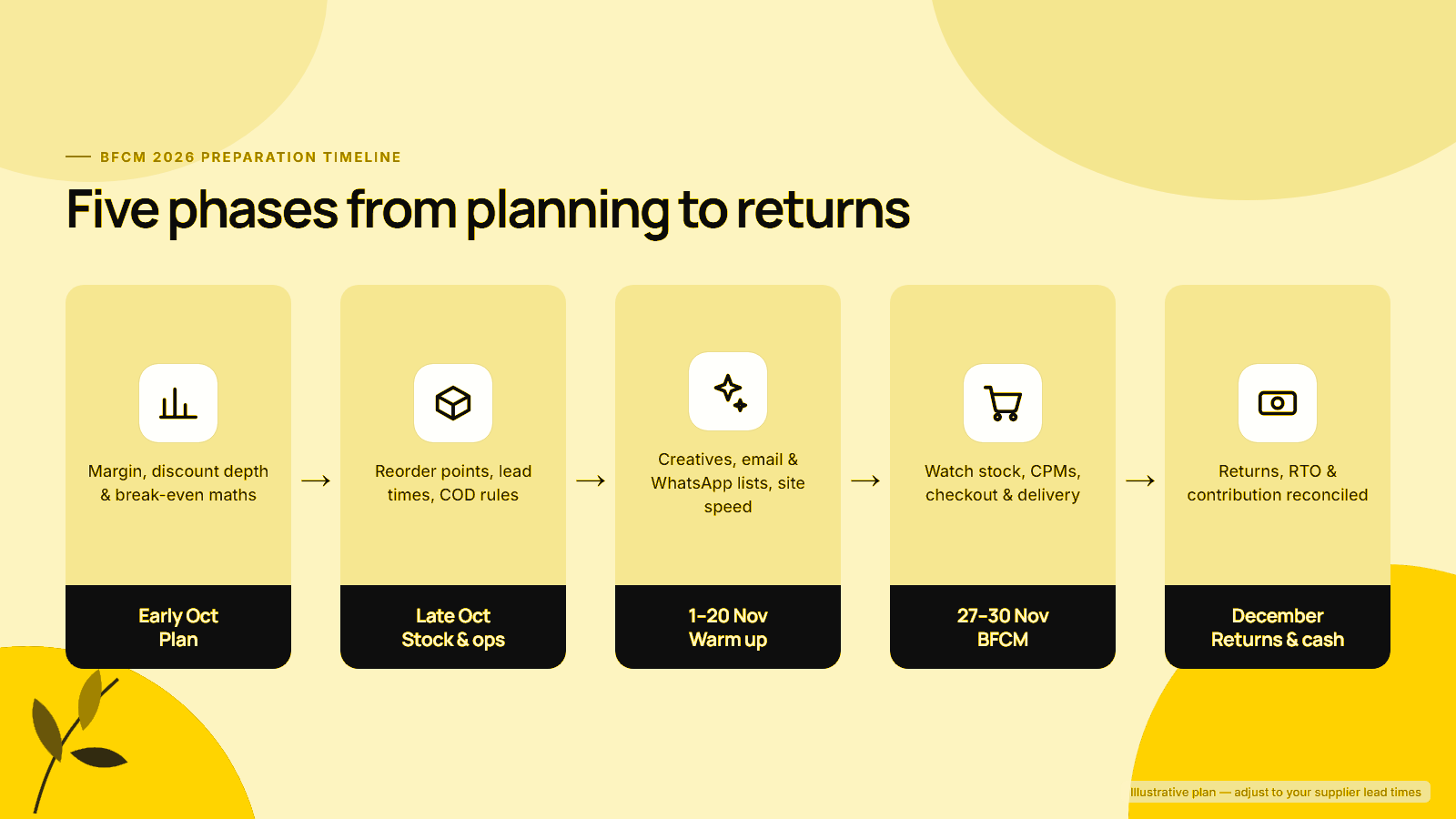
| Phase | Dates (2026) | Profit-protection checklist |
|---|---|---|
| 1. Baseline | 28 Sep to 11 Oct | Contribution per SKU, discount ceiling, hero SKUs, bundle shortlist |
| 2. Stock | 5 Oct to 18 Oct | Purchase orders placed against lead times, bundle components covered |
| 3. Offer and creative | 12 Oct to 1 Nov | Final offers, discount combination rules, creative production, list growth |
| 4. Store readiness | 26 Oct to 15 Nov | Speed checks, checkout QA, COD confirmation flow, returns policy |
| 5. Ramp | 9 Nov to 22 Nov | Ad sets out of learning, early access, stock allocation, code freeze |
| 6. Live week | 23 Nov to 1 Dec | Daily contribution, stock, ad cost and RTO review |
| 7. Returns and cash | 2 Dec to 15 Jan | Returns reserve, supplier payments, reorder decisions, runway |
Phases overlap on purpose, but do not start the ad ramp before the checkout and stock checks are complete.
How much stock should you order, and when?
The reorder point is lead-time demand plus safety stock. For BFCM, lead time includes supplier production, inbound transit and receiving. If a supplier needs 45 days and inbound takes 10, a purchase order for late-November demand must be placed in early October.
Forecast demand by SKU from last year’s BFCM units, adjusted for this year’s traffic plan and discount depth. The inventory reorder point guide explains the formula, and the inventory planner models reorder timing.
Three checks prevent the common failures:
- Cover bundle components. A bundle stocks out when any single component runs out.
- Decide on overselling. Shopify’s inventory tracking guide explains the “Continue selling when out of stock” setting. Turn it off for BFCM products unless you can fulfil backorders on time.
- Avoid overbuying slow SKUs. January leftovers tie up cash just as refunds fall due.
Ad budget when CPMs rise
Auction prices usually rise through November because more advertisers compete for the same shoppers, so plan with a stress test rather than last month’s cost per purchase. Model your maximum affordable acquisition cost per order, then check whether the plan still works if CPMs run 25% or 50% higher (illustrative scenarios, not forecasts).
Timing matters on Meta. Meta’s help centre on significant edits and the learning phase recommends waiting until an ad set has generated about 50 optimisation events after its last significant edit. Changes to the optimisation event, audience or creative count as significant edits.
For BFCM, that means:
- Test creative and offers in October and early November, not on Black Friday. On Shopify, a profit-first Rollouts test keeps those offer tests measurable.
- Enter the live week with ad sets already out of learning.
- Raise budgets in measured steps and avoid swapping creative mid-weekend.
- Warm up owned channels, such as email, SMS, WhatsApp and Instagram followers, before the sale so part of the demand arrives without paid clicks.
Set a hard daily ceiling based on contribution, not ROAS. The marketing budget calculator helps model spend scenarios before you commit.
Getting the site and checkout ready for peak traffic
Checkout friction costs more at peak because each visit was expensive to buy. Baymard’s cart abandonment research puts the documented average at 70.22%. Among shoppers in its survey who abandoned during checkout, 40% blamed extra costs being too high and 17% blamed website errors or crashes.
Speed also matters. In the Milliseconds Make Millions study by Google, Deloitte Digital and Fifty-Five, a 0.1-second mobile speed improvement was associated with 8.4% more conversions among retail consumers across 37 brands. It is a 2020 correlation study, but the direction is clear.
Before 15 November, complete this list:
- Remove or defer apps and scripts added since last year’s sale.
- Show shipping cost and delivery dates before checkout.
- Place test orders on mobile for every payment method, including COD and discount combinations.
- Confirm the returns policy is short, clear and linked from product pages.
- Freeze theme and app changes from about 20 November.
The Shopify conversion audit checklist covers the full review, and our cart abandonment guide for 2026 covers recovery flows.
Controlling COD and RTO risk during the sale
In markets where cash on delivery is common, such as India, a discount-led sale can attract impulse orders that are later refused. Each refusal costs forward and reverse freight without revenue.
That is why COD risk needs its own budget line, separate from normal returns.
Set rules before the sale, not during it:
- Confirm high-value and first-time COD orders by call or WhatsApp before dispatch. Our guide to AI calling for COD confirmation explains the setup.
- Offer a small prepaid incentive only where the RTO saving covers it.
- Flag incomplete addresses and repeat refusers automatically.
- Consider a lower COD order-value cap for the sale period.
Track COD and prepaid orders separately, because a blended RTO rate hides a weak COD segment. The RTO cost guide shows how to price that risk.
How will AI shopping assistants affect BFCM 2026 traffic?
AI assistants are becoming a measurable holiday traffic source. Adobe reported that traffic to US retail sites from generative AI tools rose 693.4% during the 2025 season, and by 670% on Cyber Monday alone. The growth starts from a small base, but it is rising quickly.
Salesforce says AI and agents influenced 20% of global Cyber Week 2025 orders, worth $67 billion. That figure includes on-site recommendations and customer-service agents, not only chat assistants. For 2026, Salesforce’s holiday predictions, published in July, forecast that 20% of holiday e-commerce traffic will originate from AI chat agents. Treat that as a prediction.
AI assistants compare prices, shipping and return terms, so accurate product data and clear offer terms matter. See our guides to agentic commerce on Shopify and tracking AI traffic in GA4.
After the sale: returns, cash and the review
BFCM cash arrives before its costs are settled. The NRF’s 2025 returns report forecast that 17% of holiday sales would be returned and that 19.3% of online sales would be returned during 2025. Refunds, RTO losses and supplier invoices all land in December and January.
Work through this list in the first two weeks of December:
- Set a returns reserve using your own return and RTO rates by category and payment method.
- Match payouts to bills. Payment gateway settlement dates rarely line up with supplier and ad-platform invoices.
- Reorder only proven SKUs. Base January stock on settled sales after returns, not gross BFCM orders.
- Review contribution by offer. Record which discounts and bundles made money for next year’s plan.
- Update runway. Recalculate cash runway after the reserve, not before.
The cash runway guide and runway planner help turn the season’s results into a January budget.
This review is where the season is judged. A store can top the revenue report and still finish the season weaker; the ones that finish stronger capped discount depth with maths, used bundles to lift order value, ordered stock against real lead times and entered the live week with ads and checkout already tested. Record the contribution per order each offer actually earned, because next year’s checklist starts from that number.
Get the store ready before peak traffic arrives
MlabsGrowth reviews product pages, offer structure, checkout friction and measurement for Shopify brands before high-spend periods such as BFCM, so paid traffic lands on a store built to convert profitably.
Get a Shopify CRO review before BFCM or book a 30-minute call.
Frequently asked questions
When is Black Friday 2026?
Black Friday 2026 is on Friday 27 November, the day after US Thanksgiving on Thursday 26 November. Cyber Monday follows on 30 November 2026. Many brands run early-access offers the week before, so treat the full window as roughly 20 November to 1 December when planning stock and ad budget.
How much extra volume does a Black Friday discount need to break even?
Divide the discount by the contribution margin left after the discount. With a 45% contribution margin, a 20% discount needs 80% more units to earn the same contribution, and a 30% discount needs 200% more. If the margin is lower, the required volume rises steeply, so deep discounts rarely pay for themselves.
Are bundles better than discounts for BFCM?
Often, yes. A bundle raises order value and spreads fixed per-order costs such as shipping, packing and ad spend across more units. A 15% bundle discount can leave more contribution per order than a 20% sitewide discount, even though the shopper sees a similar saving. Test the bundle price against your unit costs first.
When should I place BFCM inventory orders?
Work back from your supplier lead time plus inbound transit and receiving time, then add a safety buffer. If a supplier needs 45 days and inbound takes 10, the purchase order for late-November demand should be placed in early October. Prioritise hero SKUs and bundle components rather than the full catalogue.
How should I plan for returns after BFCM?
Hold back cash for refunds before spending BFCM revenue. The NRF expected 17% of 2025 holiday sales to be returned, and online return rates run higher than in-store. Use your own return and RTO rates by product and payment method, and plan reorders and ad spend after that reserve is set aside.
Source notes
- Holiday Shopping Season Drove a Record $257.8 Billion Online, from Adobe (published 7 January 2026, accessed 24 September 2026).
- Cyber Monday Hits Record $14.25 Billion in Online Spending, from Adobe (published 2 December 2025, accessed 24 September 2026).
- Shopify merchants generate record-breaking $14.6 billion in Black Friday Cyber Monday sales, from Shopify (published 2 December 2025, accessed 24 September 2026).
- Deloitte Forecasts Holiday Retail Sales to Reach $1.70 Trillion to $1.71 Trillion, from Deloitte (published 10 September 2026, accessed 24 September 2026).
- AI and Agents Propel Cyber Week to Record $336.6B in Global Spend, from Salesforce (published 5 December 2025, accessed 24 September 2026).
- 2026 Holiday Predictions, from Salesforce (published 20 July 2026, accessed 24 September 2026).
- Consumers Expected to Return Nearly $850 Billion in Merchandise in 2025, from NRF (published 15 October 2025, accessed 24 September 2026).
- Cart Abandonment Rate Statistics, from Baymard Institute (accessed 24 September 2026).
- Milliseconds Make Millions, from Google, Deloitte Digital and Fifty-Five (accessed 24 September 2026).
- Significant Edits and Learning Phase, from Meta Business Help Center (accessed 24 September 2026).
- Shopify Bundles, from Shopify Help Center (accessed 24 September 2026).
- Setting up inventory tracking, from Shopify Help Center (accessed 24 September 2026).