A shopper types “find a linen shirt under $60 that can arrive by Friday” into ChatGPT. The assistant compares products from dozens of stores, shows three, and sends the shopper to checkout. The store’s homepage, navigation and banners played no part. That is agentic commerce, and for Shopify merchants it is already a working sales channel.
Shopify reported that AI-referred orders to its merchants grew nearly 13 times year on year in Q1 2026, while referral sessions from AI chatbots grew more than 8 times. Its agentic storefronts now connect eligible stores to ChatGPT, Google AI Mode and Gemini, Microsoft Copilot and Meta from one place in the admin.
Below: what agentic commerce means for a Shopify store, which AI channels are live and where, how checkout works, what product data AI agents read and how to measure the result. A four-week plan closes the article.
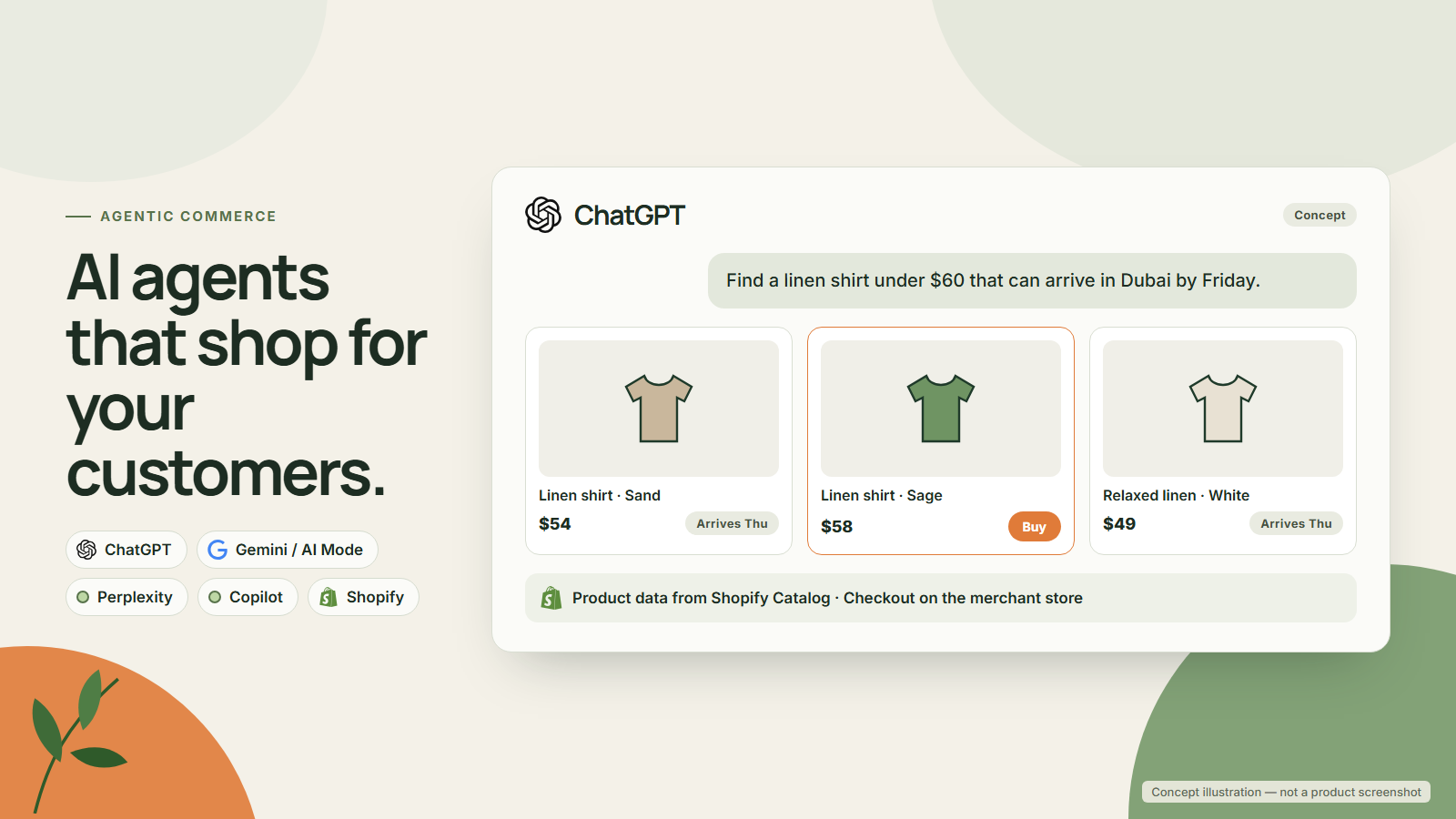
At a glance: Shopify reported AI-referred orders grew nearly 13x year on year in Q1 2026. Agentic storefronts connect eligible stores to ChatGPT, Google AI Mode and Gemini, Copilot and Meta, though most AI checkout currently serves US shoppers and eligibility differs by channel and store location. Product data quality decides visibility: complete titles, attributes, images, reviews and policies.
Platforms in this guide
 Shopify
 ChatGPT
 Google AI Mode & Gemini
Microsoft Copilot
 Meta
What is agentic commerce?
Agentic commerce is shopping in which an AI assistant finds, compares and helps buy products for a person inside a conversation. Shopify’s own explainer on agentic commerce describes agents that read product titles, descriptions, images, pricing, inventory and shipping speeds to decide what to recommend.
The shift for merchants is where the decision happens. In search, a shopper sees ten links and visits several stores. In an AI conversation, the assistant narrows the choice before the shopper sees any store, so the product data the agent can read matters more than the design of the homepage.
Agentic commerce covers a range of behaviour:
- Discovery: the assistant recommends products in answer to a question.
- Comparison: it compares options on price, attributes, reviews and delivery.
- Checkout: the shopper completes the purchase in the AI channel or on the merchant’s checkout opened from it.
Fully autonomous buying, where an agent completes a purchase with no human step, is still limited. Most live Shopify flows today end with a shopper confirming the order on the merchant’s checkout.
Growth from a small base
The channel is growing quickly, from a small base. In Q1 2026, according to Shopify’s AI search insights (11 May 2026), AI chatbot referral sessions rose more than 8 times and AI-referred orders nearly 13 times year on year. Those sessions converted nearly 50% better than organic search, and their average order value was 14% higher.
Growth continued into the second quarter. TechCrunch reported on 5 August 2026 that Shopify said AI-driven traffic and orders had tripled year on year in Q2, and that 75% of AI-attributed purchases happened outside the top 100 product categories. Long-tail products are getting found.
Outside Shopify, Adobe data reported by TechCrunch showed AI traffic to US retail sites up 393% year on year in Q1 2026, converting 42% better than non-AI traffic in March 2026. Adobe’s survey of more than 5,000 US consumers found 39% had used AI for online shopping.
For the longer view, Digital Commerce 360 reported Morgan Stanley’s forecast that agentic shopping could account for $190 billion to $385 billion of US online sales by 2030, or 10% to 20% of US ecommerce.
Shopify agentic storefronts: one admin section, several AI channels
Shopify agentic storefronts let customers discover and buy a store’s products in AI channels. Shopify’s agentic storefronts documentation lists ChatGPT, Google AI Mode and Gemini, Microsoft Copilot and Meta. The feature sits under Sales channels > Agentic in the Shopify admin and is active by default for eligible stores.
Shopify introduced agentic storefronts in its Winter ’26 Edition on 10 December 2025, launching with ChatGPT, Perplexity and Microsoft Copilot. The current help page lists the channels above, so check your own admin for Perplexity’s status. Meta became an AI channel in the admin on 8 September 2026, according to the Shopify changelog, which says products are shared with Meta by default through Shopify Catalog.
The point of one agentic section is that a merchant manages product eligibility, data and reporting once rather than integrating with each AI company separately. Shopify syndicates the catalogue; each AI channel then decides relevance and ranking with its own logic. Price data travels the same way, so check how Shopify Catalog now passes compare-at prices to AI agents before a sale.
Which AI channels can Shopify stores sell in?
Each channel has its own eligibility rules. ChatGPT accepts stores based outside the US if they sell to US customers, while Google AI Mode and Gemini require a US-based store. Direct checkout in most channels currently shows only to US shoppers. Shopify lists no channel fees for ChatGPT, Google or Copilot beyond standard payment processing.
| AI channel | Store eligibility (per Shopify) | Checkout | Channel fee |
|---|---|---|---|
| ChatGPT | Must sell to US customers; store can be based outside the US; store policies completed | Merchant’s online store checkout in an in-app browser or new tab | None; standard payment processing only |
| Google AI Mode and Gemini | Store based in the US, selling to US customers; Google Merchant Center required | Direct checkout, on by default | None listed |
| Microsoft Copilot | Must sell to US customers | Direct checkout shown only to US-based customers | None listed |
| Meta | Products shared through Shopify Catalog by default | Direct checkout for customers in the US, Canada or Mexico | Check current terms |
Sources: Shopify Help Center pages for ChatGPT, Google AI Mode and Gemini and Microsoft Copilot, retrieved 24 September 2026. Eligibility is changing quickly, so treat your admin as the source of truth.
For merchants in the UK, India, the UAE, the EU or Australia, the practical path today is ChatGPT if you already ship to the US. Everyone else should prepare product data now so the store is ready when checkout reaches their market. Our Google UCP checkout guide covers Google’s international plans in detail.
How does checkout work in AI channels?
That depends on the channel. For ChatGPT, Shopify says shoppers pay on the merchant’s full online store checkout, shown in a ChatGPT in-app browser or a new tab on the web. Google AI Mode, Gemini and Copilot use direct checkout for eligible US shoppers. In every case the merchant remains the seller and receives the order in Shopify.
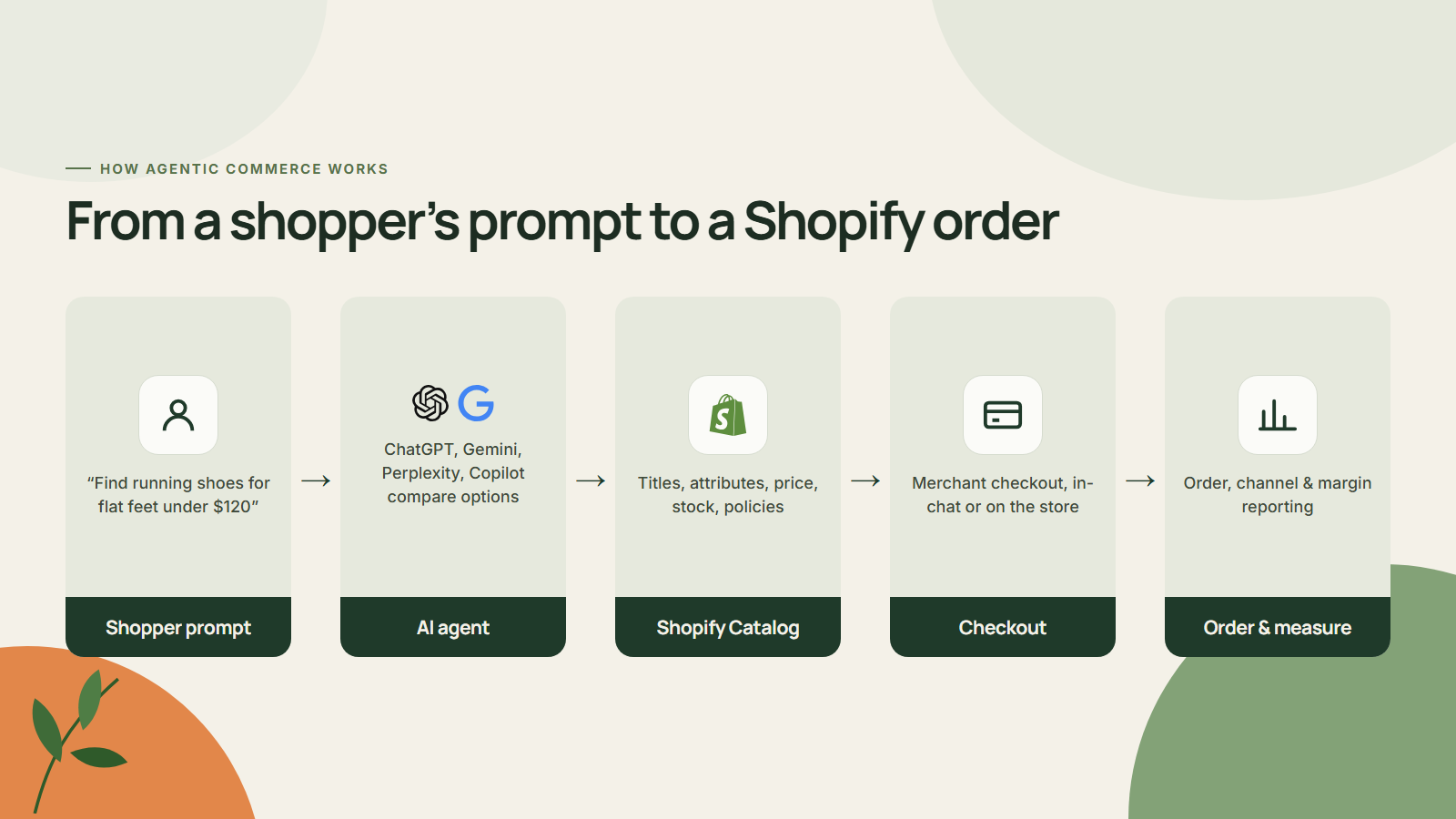
ChatGPT’s checkout changed in 2026. OpenAI launched Instant Checkout in September 2025, then moved away from it in March 2026 to focus on product discovery and let merchants use their own checkout experiences, as Checkout.com and Digital Commerce 360 reported. That is why Shopify now opens the store’s own checkout inside ChatGPT.
Keeping the merchant’s checkout has practical benefits: the store’s payment methods, discounts, shipping rules and brand stay in place. It also means checkout friction still matters. Our cart abandonment guide covers the fixes that apply to AI-referred shoppers as much as anyone. Paid placements are a separate path; see ChatGPT Ads for Shopify.
The plumbing: Shopify Catalog, UCP and ACP
Three pieces of infrastructure sit behind agentic commerce. Shopify Catalog organises product data, Google’s Universal Commerce Protocol (UCP) lets agents and stores transact, and the Agentic Commerce Protocol (ACP), maintained by OpenAI and Stripe, does the same for ChatGPT’s ecosystem. Merchants do not need to implement any of them directly to use agentic storefronts.
| Name | What it is | Who is behind it |
|---|---|---|
| Shopify Catalog | A catalogue of billions of products that uses specialised LLMs to categorise, enrich and standardise product data | Shopify (announcement, developer docs) |
| Universal Commerce Protocol (UCP) | An open standard for agentic commerce across the shopping journey; powers checkout in AI Mode and Gemini | Google; co-developers include Shopify, Etsy, Wayfair, Target and Walmart (Google) |
| Agentic Commerce Protocol (ACP) | An open standard for connecting buyers, their AI agents and businesses to complete purchases | OpenAI and Stripe, Apache 2.0 licence (GitHub) |
Shopify’s developer documentation notes that both its Global Catalog, which searches across Shopify merchants, and its Storefront Catalog, which covers a single store, implement the UCP Catalog capability. For a merchant, the takeaway is simple: Shopify handles the protocols, and the merchant’s job is the data those protocols carry.
Preparing product data for AI agents
The job is to complete and structure your product data. Shopify’s agentic storefronts products page says Catalog shares each product’s title, description, options, images, price, availability and other key attributes, and recommends complete, well-structured product information. The admin’s Listing quality check scores five areas you can fix today.
Shopify’s agentic home page lists those five Listing quality areas:
- Description completeness: say what the product is, who it is for, materials, dimensions and use cases in plain words.
- Image coverage: every variant has images, including scale and detail shots.
- Product reviews: real reviews that mention use cases and fit.
- Variant and option completeness: sizes, colours and materials as structured options, not only in the title.
- Shop policy completeness: shipping, returns, refund and contact policies filled in.
If your attributes live in metafields, metaobjects or tag prefixes, Shopify recommends Catalog Mapping so the AI channel can read them. The same page warns that AI channels often re-rank results with their own logic, so no setting guarantees placement.
Write for the question, not the keyword. AI shoppers ask “waterproof hiking boots for wide feet under $150”. A product that states width, waterproof rating and price in structured fields can answer that question. A product titled “Summit Pro Boot” with a lifestyle paragraph cannot.
Our Shopify SEO for AI search guide goes attribute by attribute and covers the page-level work too.
Measuring AI orders by channel and by margin
Start with Shopify’s agentic reporting, then confirm in your analytics. The agentic section of the admin reports sales, orders, online store sessions and online store conversion for each AI channel, plus a total. Orders from AI channels carry channel or referrer attribution, so you can see where each one originated.
Beyond the admin, track three things:
- AI referral traffic in GA4. GA4 added a native AI Assistant channel in May 2026. To catch what it misses, see how to track AI traffic in GA4.
- Contribution per AI order. AI orders may carry different discount, return and shipping patterns. Run them through the unit economics calculator.
- Which products get recommended. Shopify’s Q2 note that 75% of AI purchases fell outside the top 100 categories suggests long-tail products deserve data attention too.
Judge the channel by profit, not only revenue. Once paid AI placements enter the mix, the POAS vs ROAS guide shows why that distinction matters.
Frequently asked questions
What is agentic commerce?
Agentic commerce is shopping in which an AI assistant such as ChatGPT, Gemini or Copilot finds, compares and helps buy products for a shopper inside a conversation. For merchants, it means product data is read and ranked by AI agents, and the order can be placed in an AI channel rather than on the store’s homepage.
What are Shopify agentic storefronts?
Shopify agentic storefronts let customers discover and buy a store’s products in AI channels such as ChatGPT, Google AI Mode and Gemini, Microsoft Copilot and Meta. They are managed under Sales channels > Agentic in the Shopify admin and are active by default for eligible stores.
Can stores outside the US sell through Shopify agentic storefronts?
Partly. For ChatGPT, Shopify says the store must sell to customers in the United States but can be based outside the US. Google AI Mode and Gemini require a store based in the US. Direct checkout in most AI channels currently serves US shoppers, with Meta also covering Canada and Mexico.
Does Shopify charge fees for selling in ChatGPT?
No. Shopify’s help page for selling on ChatGPT says there are no fees associated with selling in ChatGPT and merchants pay only their standard payment processing fees. The Google AI Mode, Gemini and Microsoft Copilot channels are also listed without channel fees.
How do I prepare my Shopify store for AI shopping agents?
Complete every product’s title, description, images, options, price and availability, fill in store policies, collect product reviews, and map data held in metafields with Shopify Catalog Mapping. Then check the Listing quality score in the agentic storefronts section of the admin and track AI orders separately.
Your first four weeks with agentic storefronts
Check eligibility, fix product data on your best sellers, fill in policies and set up measurement. Agentic storefronts are on by default for eligible stores, so the first job is confirming what is already live in your admin and whether the data behind it would win a comparison against a competitor.
| Week | Action |
|---|---|
| Week 1 | Open Sales channels > Agentic; confirm which channels are active and check the Listing quality score |
| Week 2 | Rewrite titles, descriptions and options for your top 20 products; add missing images and variant data |
| Week 3 | Complete store policies, collect reviews on key products, map metafields with Catalog Mapping |
| Week 4 | Set up AI channel tracking in GA4, build a monthly AI orders and margin report, and test prompts in ChatGPT and Gemini |
Eligibility is still mostly US-first, but most of this work does not depend on it. Complete product data, clear policies, real reviews and margin-level measurement count in every market, so a store outside the US can do the same work before checkout arrives.
Before peak season, align this work with your offer and stock planning. Our BFCM 2026 profit checklist covers the dates to plan around.
Get your store ready for AI shopping agents
MlabsGrowth audits Shopify product data, agentic storefront settings and AI channel tracking, then fixes the gaps that stop AI assistants from recommending your products.
Source notes
- Shopify Help Center, Shopify agentic storefronts, retrieved 2026-09-24.
- Shopify Help Center, Selling on ChatGPT, retrieved 2026-09-24.
- Shopify Help Center, Selling on Google AI Mode and Gemini, retrieved 2026-09-24.
- Shopify Help Center, Selling on Microsoft Copilot, retrieved 2026-09-24.
- Shopify Help Center, Managing agentic storefronts, retrieved 2026-09-24.
- Shopify Help Center, Products in agentic storefronts, retrieved 2026-09-24.
- Shopify Changelog, Meta is now an AI channel in your admin, published 2026-09-08, retrieved 2026-09-24.
- Shopify News, Introducing Shopify Agentic Storefronts, published 2025-12-10, retrieved 2026-09-24.
- Shopify News, AI commerce at scale, published 2026-01-11, retrieved 2026-09-24.
- Shopify, AI-referred shoppers convert better and spend more, published 2026-05-11, retrieved 2026-09-24.
- Shopify, How agentic commerce works, retrieved 2026-09-24.
- Shopify.dev, Catalog, retrieved 2026-09-24.
- Google, New tech and tools for retailers to succeed in an agentic shopping era, published 2026-01-11, retrieved 2026-09-24.
- Agentic Commerce Protocol on GitHub, retrieved 2026-09-24.
- Checkout.com, OpenAI’s agentic commerce shift, published 2026-04-20, retrieved 2026-09-24.
- Digital Commerce 360, OpenAI shifts checkout plans in agentic commerce strategy, published 2026-03-06, retrieved 2026-09-24.
- TechCrunch, Shopify says AI search is driving more traffic and sales, published 2026-08-05, retrieved 2026-09-24.
- TechCrunch, AI traffic to US retailers rose 393% in Q1, published 2026-04-16, retrieved 2026-09-24.
- Digital Commerce 360, Morgan Stanley: agentic shoppers could drive up to $385 billion in online sales, published 2025-12-09, retrieved 2026-09-24.
