Most small and mid-sized ecommerce brands need a consolidated sales campaign with roughly 10 to 25 genuinely different active ads, plus a weekly flow of new concepts sized to their budget. Meta’s own guidance recommends at least 20 diversified ads in Advantage+ sales campaigns. The real limit is how many distinct ideas your budget can afford to test.
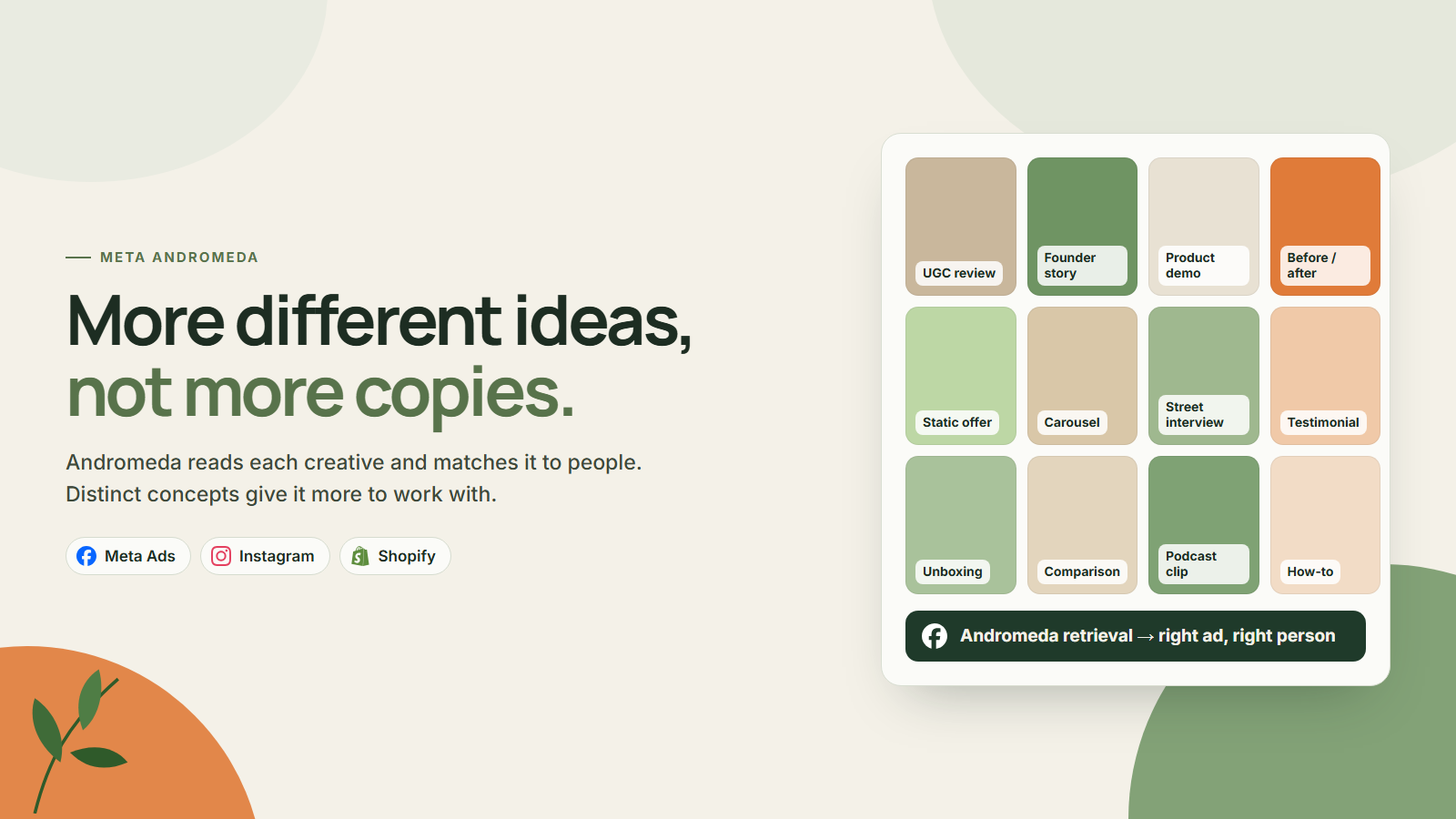
Meta Andromeda, the retrieval system Meta introduced in December 2024, decides which ads are shortlisted for each person. Because Meta now relies on your creative to find buyers, a thin or repetitive ad set gives it little to work with.
Below: what Andromeda does, what “different” creative means, a practical 2026 account structure, and how to tie creative volume to budget, ending with where to start if your account already runs.
What changes in your account
- Retrieval now runs through Andromeda, the ad retrieval engine Meta announced on 2 December 2024.
- The ad count goes up: Meta recommends at least 20 diversified ads in Advantage+ sales campaigns.
- Similar-looking ads may be treated as the same ad and shown to the same people, so variety has to be real.
- Size creative testing to budget, and judge winners on contribution margin, not ROAS alone.
Platforms in this guide
 Meta Ads
 Instagram
 Shopify
In this guide
- What Meta Andromeda is
- Why creative now beats targeting
- What genuinely different creative means
- A practical account structure
- How many creatives your budget supports
- A creative production workflow
- How to measure creative performance
- Where to start with an existing account
- Frequently asked questions
What is Meta Andromeda?
Meta Andromeda is the machine learning system that runs the retrieval stage of Meta’s ad delivery. According to Meta’s engineering team, retrieval selects a few thousand relevant ads from tens of millions of candidates before later ranking stages choose what a person actually sees. Meta announced it on 2 December 2024.
In Meta Andromeda: Supercharging Advantage+ automation with the next-gen personalized ads retrieval engine, Meta reported a 6% recall improvement in retrieval and an 8% improvement in ads quality on selected segments. It also described a 10,000x increase in model capacity for personalisation, and said the number of ad creatives in its systems was expected to grow significantly as advertisers adopt generative AI tools.
For an advertiser, retrieval is a filter. If your ad never makes the shortlist for a person, the bid and budget behind it do not matter for that impression.
Creative now does the targeting
Meta says it directly. Its April 2025 article on creative diversification states that the focus has shifted “from niche targeting to creative diversification” as the best lever for finding relevant audiences. When targeting is broad, the ad itself tells the system who might care, so each distinct creative opens a different pocket of buyers.
In that April 2025 article on Andromeda and diversification, Meta describes diversification as producing creatives “with different themes, messages, and visuals” for different audience segments. It also reports that advertisers saw a 9% lower average cost per action with the new streamlined Advantage+ sales campaign setup.
Consultant Jon Loomer puts the practical effect well in his breakdown of Andromeda and creative diversification: many detailed targeting inputs now act as suggestions, and speaking to specific pain points in the ad is how you reach the right person.
Creative has always mattered. Nielsen’s 2017 analysis of nearly 500 FMCG campaigns still called creative the most important element. A widely shared “56%” figure for creative does not appear in that Nielsen article, so we do not rely on it.
What counts as a genuinely different creative?
A genuinely different creative changes what the ad says or who it speaks to, not just how it looks. Meta’s creative guidance warns that when creative is too similar, its system “may not recognize it as different” and could deliver it to the same audiences. That overlap can lead to Creative limited or Creative fatigue statuses.
Meta’s small-business guide, Successful ads tell a story in more ways than one, suggests formats such as listicles, product demos, Q&A, and point-of-view videos. Use four levers to judge whether two ads are actually different:
| Lever | Genuinely different | Minor variation (usually not enough) |
|---|---|---|
| Concept | Problem-solution demo versus customer testimonial | Same demo with a new background colour |
| Angle | “Saves 20 minutes a morning” versus “gift for a new parent” | Same benefit with a reworded headline |
| Persona | First-time buyer, repeat gifter, professional user | Same persona, different stock model |
| Format | 9:16 UGC video, static comparison, carousel of use cases | Same video trimmed from 20 to 18 seconds |
Loomer’s seven examples make the same point: two images that look alike are unlikely to change performance. He also notes that Flexible format or Dynamic Creative lets one ad hold up to 10 images or videos, so a small number of ads can still carry a diverse asset set.
A quick test we use: describe each ad in one sentence without mentioning colours, fonts, or crop. If two ads produce the same sentence, count them as one concept. Most accounts that claim 30 active ads have fewer than 10 concepts by this test.
A consolidated account structure for 2026
For most small and mid-sized ecommerce brands, the working structure is one main Advantage+ sales campaign for prospecting and retained demand, a small testing lane for new concepts, and very few ad sets. Meta renamed Advantage+ shopping campaigns to Advantage+ sales campaigns in 2025, and its product page reports a 20% lower average cost per result.
That figure comes from Meta’s Advantage+ sales campaigns page and is Meta’s own average, not a guarantee. The campaign automates audience, placements, and budget, so your main levers become creative and conversion data. As of 24 September 2026, options can differ by account, so check your Ads Manager.
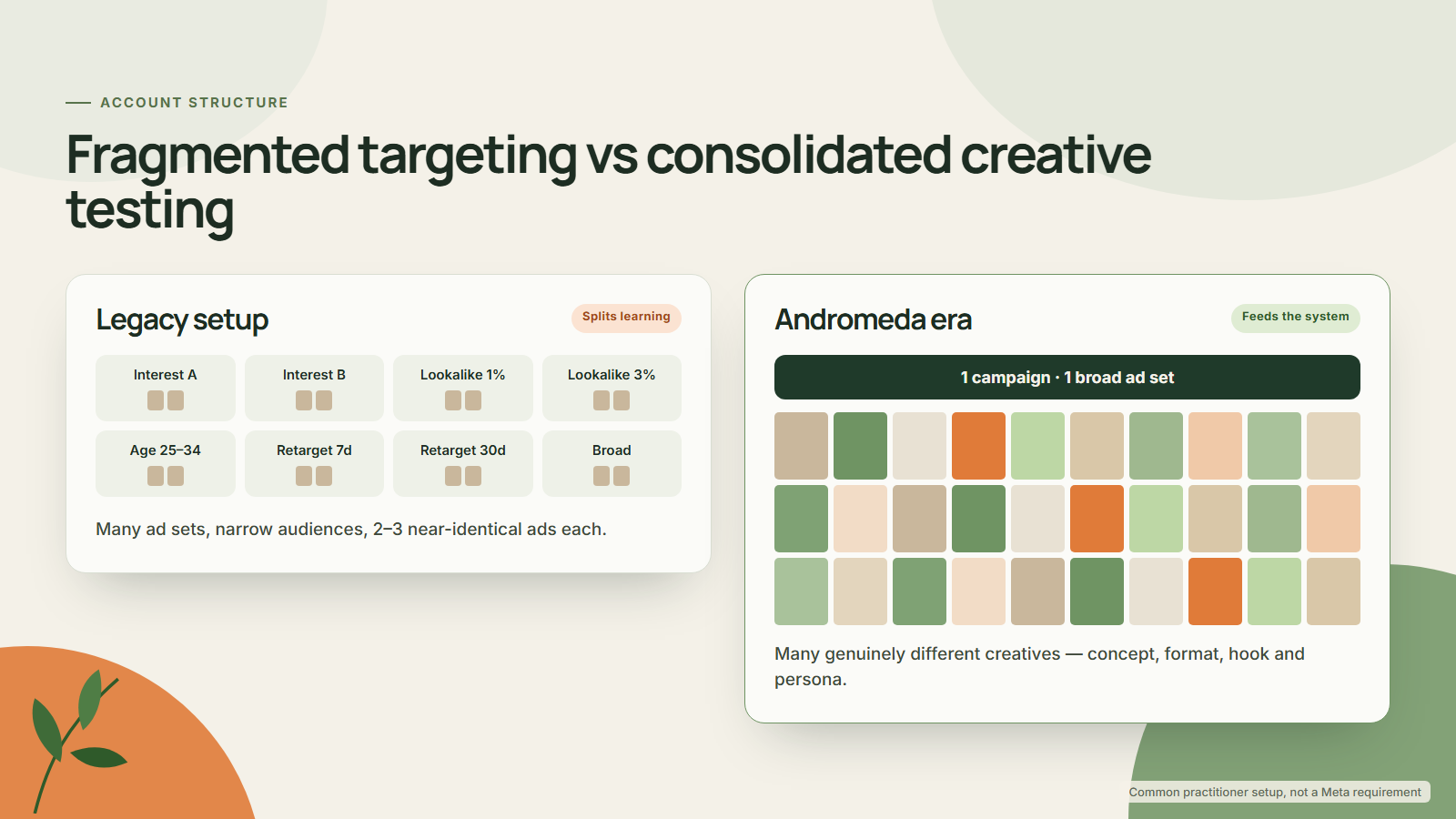
A practical layout looks like this:
- Main sales campaign: Advantage+ sales, broad audience, one or two ad sets, your proven and newly graduated creatives.
- Testing lane: a separate campaign or ad set that receives a fixed share of spend for new concepts. Meta’s three-step diversification guide suggests dedicating 20-30% of the overall ad budget to testing new ads.
- Optional catalogue campaign: for larger catalogues, a product-set campaign using your Shopify feed.
- Exclusions and settings: handle legal, geographic, and existing-customer rules at campaign level instead of creating new ad sets for each audience idea.
Fragmentation hurts because learning happens at the ad set level. Meta’s help documentation on last significant edit advises waiting for about 50 optimisation events after a significant edit before reading costs as stable.
Ten small ad sets rarely reach that point. One well-funded ad set does.
How many creatives per ad set does your budget support?
Meta’s November 2024 guidance recommends “at least 20 diversified ads” in Advantage+ sales campaigns and says leading advertisers launch new ads weekly. Practitioners often quote 15 to 50 creatives per consolidated ad set, but that range comes from agency and consultant experience, not from Meta. Your budget decides how many ideas you can fairly judge.
Loomer notes that many advertisers have moved from the older recommendation of six ads to 10, 20, or more. At small budgets, Meta often concentrates spend on two or three ads and the rest never get enough delivery to prove anything. Match testing volume to the money available to read results:
Concepts you can test per month = (monthly Meta budget × testing share) ÷ (target cost per purchase × spend multiple)
The spend multiple is how much you let a new concept spend, in multiples of target CPA, before deciding to keep or cut it. We use 3x as a starting rule of thumb; it is our working assumption, not a Meta rule.
Illustrative example (hypothetical brand, target cost per purchase ₹800, testing share 25%, spend multiple 3x, so ₹2,400 per concept):
| Monthly Meta budget (illustrative) | Testing budget at 25% | Concepts you can test per month | New concepts per week | Active distinct ads in main campaign |
|---|---|---|---|---|
| ₹1,00,000 | ₹25,000 | About 10 | 2-3 | 8-12, using Flexible format for extra assets |
| ₹3,00,000 | ₹75,000 | About 31 | 7-8 | 15-25 |
| ₹10,00,000 | ₹2,50,000 | About 104 | 20-25 | 25-40, split across two ad sets if needed |
| ₹30,00,000 | ₹7,50,000 | About 312 | 60-75 | 40-50+, with a dedicated production system |
These numbers are illustrative only; change the target CPA and the table moves. A brand with a ₹2,000 CPA and ₹1 lakh budget can test only about four concepts a month, so it should favour bigger swings over small variations.
To set the budget itself, use the marketing budget calculator and the method in our marketing budget guide. If you are planning for the sale season, the BFCM 2026 profit checklist covers how to load new creative before costs rise.
A weekly creative production cycle
A sustainable workflow runs weekly: review results, write briefs from what worked, produce new concepts from creators, founders, and AI-assisted tools, then run a human review before launch. Meta’s own three-step guide describes this loop and reports that businesses using partnership ads with creators reduced CPAs by 19% on average.
A weekly cycle for a small team:
- Monday: review. Pull the last 7 days by ad. Note which concepts took spend, held attention, and drove profitable orders.
- Tuesday: brief. Write 5-10 short briefs, each naming one persona, one purchase blocker, one angle, and one format. Meta’s guide recommends personas built around “different customer needs and blockers to purchase”.
- Wednesday to Thursday: produce. Mix sources:
- UGC and creators: customers or paid creators showing the product in use, run as partnership ads where suitable.
- Founder ads: a direct-to-camera explanation of why the product exists. Cheap to make, and visibly different from polished brand work.
- AI-assisted variations: script drafts, hook options, copy variants, and format adaptations. Meta reports that campaigns using Advantage+ creative image generation saw an 11% higher click-through rate and 7.6% higher conversion rate, a platform-reported average.
- Friday: human review and launch. Check every ad before it goes live.
The review step is not optional. AI tools can invent claims, misstate sizing or ingredients, or drift from your brand voice. Check claims against the product page, confirm offers and prices, and make sure the ad matches the landing page.
Consistent briefs depend on consistent inputs. Our AI brand context workflow shows how to give AI tools a reusable brand, product, and customer file. For the wider set of automations around this cycle, see AI marketing workflows for ecommerce.
Measuring creative from hook rate to margin
Measure each creative at three levels: attention (hook rate), response (click-through and conversion rate), and profit (contribution margin per order). Motion defines hook rate as 3-second video plays divided by impressions. A creative that wins on attention but loses on profit is not a winner for the business.
| Metric | What it tells you | Where to find it |
|---|---|---|
| Spend share | Whether Meta is choosing the ad | Ads Manager, ad-level breakdown |
| Hook rate | Whether the first 3 seconds stop the scroll | 3-second video plays ÷ impressions |
| Click-through rate (link) | Whether the message earns interest | Ads Manager |
| Cost per purchase and conversion rate | Whether interest turns into orders | Ads Manager and Shopify |
| Contribution margin after ad cost | Whether the orders make money | Your own margin model |
The hook-rate formula follows Motion’s glossary definition. Treat benchmark ranges from vendors cautiously, because they vary by category and audience.
Most creative reporting stops before profit. A discount-led creative may show strong ROAS while attracting low-margin orders or heavy returns. Compare creatives on profit on ad spend using the approach in POAS vs ROAS, and keep your per-order costs current with the unit economics guide.
Also watch for Meta’s Creative fatigue and Creative limited signals where they appear. They usually mean the set is too narrow, and the fix is a new concept rather than a new crop.
Where to start with an account that already runs
Andromeda did not make targeting worthless, but it moved the main lever to creative. If your account was built for the older interest-based approach, work through it in this order:
- Count real concepts. Describe each active ad in one sentence without colours, fonts or crop, and merge the ads that produce the same sentence.
- Consolidate. Fold small interest-based ad sets into one main Advantage+ sales campaign, with a separate testing lane taking a fixed share of spend.
- Size the testing. Use the concepts-per-month formula with your own target cost per purchase, so every new concept gets enough spend to be read.
- Start the weekly cycle. Brief by persona, blocker, angle and format, tag each ad name with those labels, and keep the human review before launch.
- Judge on profit. Pick winners on contribution margin after ad cost, not ROAS alone.
A smaller set of truly different ideas will beat a large pile of near-duplicates.
Build a creative system that keeps pace with Andromeda
MlabsGrowth sets up AI-assisted briefing, variation, and review workflows so ecommerce teams can ship more genuinely different ads each week, with a human check before anything goes live.
Build an AI creative-brief workflow for Meta ads or book a 30-minute call.
Frequently asked questions
What is Meta Andromeda?
Andromeda is Meta’s machine learning system for ad retrieval, the first stage of ad delivery. Meta’s engineering team says retrieval narrows tens of millions of candidate ads to a few thousand relevant ones before ranking. Meta introduced it publicly on 2 December 2024 as a way to strengthen Advantage+ automation.
How many ads should an ecommerce brand run under Andromeda?
Meta’s November 2024 guidance recommends at least 20 diversified ads in Advantage+ shopping campaigns, now called Advantage+ sales campaigns. Smaller budgets may not fund that many separate reads, so combine a smaller set of distinct ads with Flexible format assets and add new concepts every week.
Does creative diversification mean making more ads?
Not by itself. Meta warns that creative which is too similar may not be recognised as different and could be delivered to the same audiences. Diversification means changing the concept, angle, persona, or format, not only the colour, crop, or a word in the headline.
Is audience targeting still useful on Meta in 2026?
It still has a role for exclusions, legal limits, and market settings, but Meta says the focus has shifted from niche targeting to creative diversification as the best lever for finding relevant audiences. In practice, the creative now does much of the audience selection that interests and demographics once did.
Which metrics show whether a creative is working?
Review spend share, hook rate (3-second video plays divided by impressions), click-through rate, cost per purchase, and conversion rate for each ad. Then check contribution margin after product, shipping, returns, and ad cost, because a high-ROAS creative can still attract unprofitable orders.
Source notes
- Engineering at Meta, Meta Andromeda: Supercharging Advantage+ automation with the next-gen personalized ads retrieval engine, published 2024-12-02, retrieved 2026-09-24.
- Meta for Business, The Creative Advantage: Unlocking the Power of Diversification with Meta Andromeda, published 2025-04-22, retrieved 2026-09-24.
- Meta for Business, Three steps to optimize your performance with creative diversification, published 2024-11-19, retrieved 2026-09-24.
- Meta for Business, Successful ads tell a story in more ways than one (creative differentiation), retrieved 2026-09-24.
- Meta for Business, Meta Advantage+ sales campaigns, retrieved 2026-09-24.
- Meta Business Help Center, Last significant edit, retrieved 2026-09-24.
- Jon Loomer Digital, Meta Andromeda and Creative Diversification: 7 Examples Explained, published 2025-10-20, retrieved 2026-09-24.
- Nielsen, When it comes to advertising effectiveness, what is key?, published October 2017, retrieved 2026-09-24.
- Motion, What is thumbstop rate / hook rate?, retrieved 2026-09-24.
