Shopify Campaign Autopilot is an AI tool in the Shopify admin that recommends, launches and adjusts marketing across Meta ads, Shop Campaigns, Microsoft Advertising and email, within a budget and guardrails you set. Shopify has published no results showing it makes merchants money, so the honest answer is that it is unproven.
That does not make it a bad idea. It makes it a test.
The risk is not that Autopilot fails to spend; it is that it spends efficiently against a revenue target while your contribution margin, returns and cash-on-delivery refusals sit outside what it optimises.
This guide separates what Shopify has documented from what is still open, then gives a profit-first test plan: a holdout, POAS guardrails, budget caps and creative approval. We have not used Autopilot ourselves, so this is an evidence-based evaluation framework, not a hands-on review.
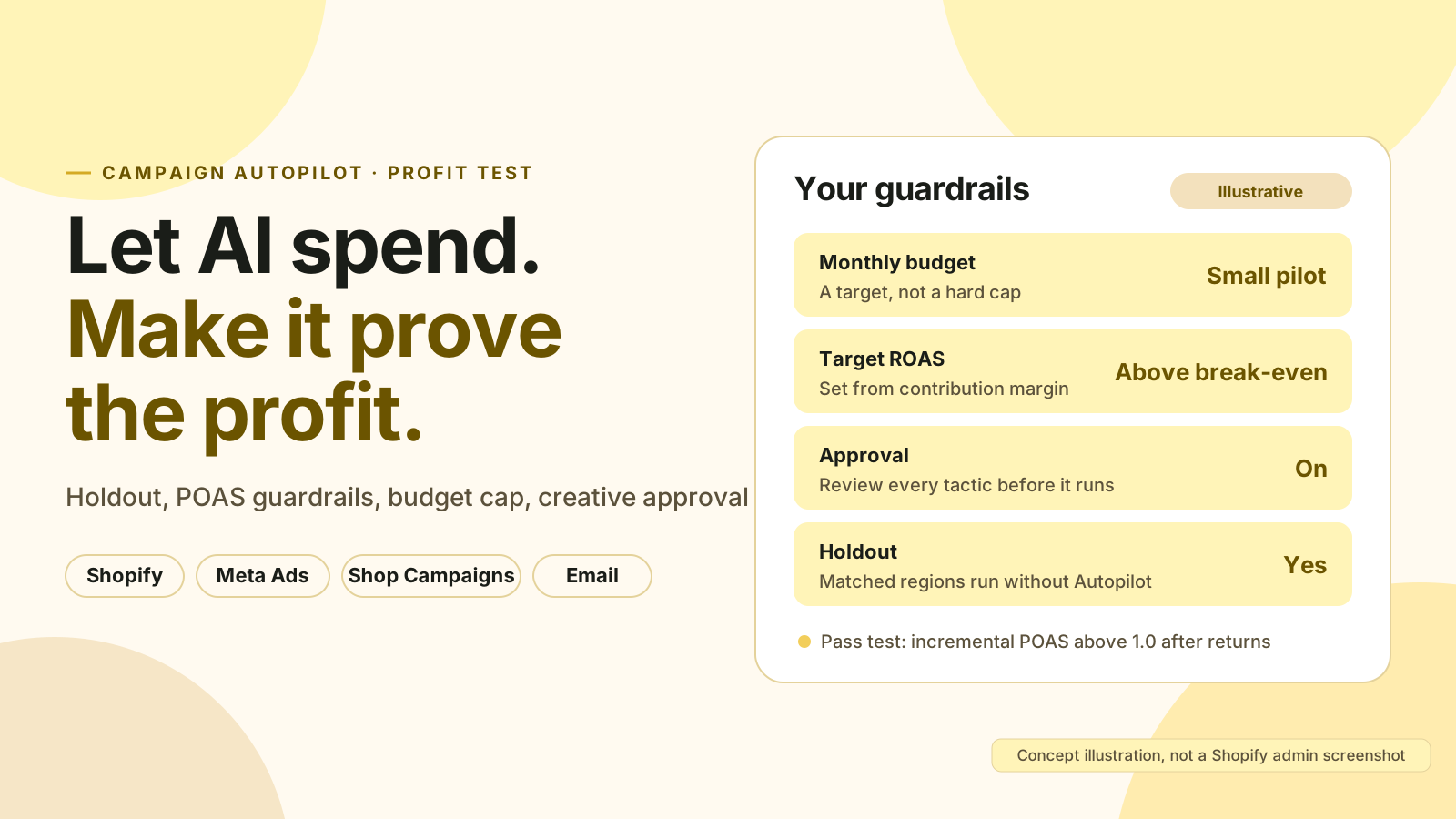
Where things stand: Campaign Autopilot was announced on 17 June 2026 and is free to use; you pay only for ad spend and sends, and Shopify states it cannot guarantee results. Its monthly budget is a target, not a cap, and its documented ROAS guardrail is revenue-based, not profit-based. Haus’s 640 Meta experiments found manual campaigns beat Advantage+ on incremental ROAS for 58% of brands, so test before you trust: run a capped pilot with approval on and a holdout, and judge it on incremental POAS after returns.
Platforms in this guide
 Shopify
 Meta Ads
 Instagram
 Google Ads
 ChatGPT Ads
 Snapchat
In this guide
- What Campaign Autopilot is
- What is still unknown
- Why ROAS is the wrong pass mark
- Evidence on AI campaigns
- The profit-first test plan
- Guardrails and stop rules
- Creative approval
- Switch on, test or wait
- Frequently asked questions
What is Shopify Campaign Autopilot, and who can use it?
Campaign Autopilot lives under Growth, then Autopilot, in the Shopify admin. You connect channels, set a monthly budget and guardrails, and approve or dismiss the tactics it proposes. Shopify announced it on 17 June 2026 as an early-access feature for paid plans.
It appeared in Shopify’s June 2026 Edition, which the Editions page labels Spring ’26 and some coverage calls Summer ’26. The Shopify Sidekick guide covers other AI features from the same release.
The Help Center lists four channels: Shopify Messaging (email), Shop Campaigns, Meta Ads and Microsoft Advertising. Shopify’s product page lists ChatGPT Ads and Snapchat as coming soon; our ChatGPT Ads guide covers that channel.
Requirements matter more than they look. The Help Center says your store must have Shopify Payments active, shipping set up, and refund and shipping policies published, and the plan must be any subscription other than Agentic. The product page still says early access, so confirm what your own admin shows. Shopify says Campaign Autopilot has no extra fee.
It reads your catalog, customer segments, order history and revenue data, and it does not change your existing manual campaigns, prices or store settings.
What has Shopify not told us yet?
Shopify’s documentation describes controls clearly but publishes no performance data. The launch post says Shopify cannot guarantee specific results and that results take time. As of 1 October 2026, several questions a profit-minded merchant needs answered are not covered in the pages we read.
- How ROAS is measured. The Help Center mentions a target return on ad spend guardrail but does not explain the attribution method or window. Some third-party write-ups say Autopilot uses Shopify order data; we could not confirm that from Shopify’s own pages.
- Whether product cost enters the decision. The documented data inputs include prices and revenue. Product cost, returns and contribution margin are not listed.
- How it allocates across channels. The documentation does not show the logic for shifting budget.
- Any benchmark. No published before-and-after data exists for early-access merchants that we could find.
Shopify does document some limits. The monthly budget is a target that Autopilot can exceed because of delayed attribution, and when a campaign starts, actual acquisition cost or ROAS can miss your targets. Editing an Autopilot campaign directly in Meta might be overwritten on the next update.
Why a revenue-based ROAS target falls short
ROAS ignores product cost, shipping, payment fees and returns, so the same ROAS can be profitable for one store and loss-making for another. Break-even ROAS equals 1 divided by contribution margin after returns.
A target set below that number buys revenue at a loss.
Illustrative example (₹): an order worth ₹2,000 leaves ₹900 after product cost (₹900) and fulfilment (₹200). Assume ₹120 of expected returns and RTO cost per order, leaving ₹780, a 39% contribution margin.
| ROAS on the order | Ad cost per order | Contribution after ads | POAS | Result |
|---|---|---|---|---|
| 2.0 | ₹1,000 | −₹220 | 0.78 | Loss |
| 2.5 | ₹800 | −₹20 | 0.98 | Roughly break-even loss |
| 3.0 | ₹667 | +₹113 | 1.17 | Small profit |
| 4.0 | ₹500 | +₹280 | 1.56 | Profit |
These figures are invented for illustration. In this store, break-even ROAS is 2.56, so a 2.5 target is a loss. Our POAS vs ROAS guide explains the calculation, and the unit economics calculator gives you your own margin.
Platform-reported ROAS adds a second problem. If only 80% of reported revenue is truly incremental (an assumption for illustration), a reported ROAS of 3.0 becomes 2.4 incremental, which is a POAS of 0.94 in this example. That is why the test plan below compares against a holdout.
What does independent evidence say about AI-run ad campaigns?
Independent evidence on AI-run campaigns is mixed, and Autopilot itself has none yet. The closest proxy is Meta’s Advantage+, which Autopilot recommends for Meta ads. Haus, an incrementality measurement company, analysed 640 Meta experiments published in July 2025.
Its findings: Meta drove about 19% lift to brands’ primary KPI on average, and 58% of brands saw higher incremental ROAS on manual campaigns than on Advantage+, which showed 12% lower DTC incremental ROAS overall. Advantage+ was 9% better at the experiment midpoint but 12% worse by the end.
Treat that with care. The average advertiser in the study spent about $14 million a year on Meta, far above a typical Shopify store, and Haus sells measurement, so it has an interest in testing. Autopilot is also a separate layer on top of Meta’s tools, not the same thing.
The lesson Haus draws is simply to test for your own business.
Meta’s own Advantage+ page cites a $4.52 average return on ad spend and 22% higher returns for advertisers using Advantage+ shopping campaigns. That is a vendor claim with no stated date or method, and it measures platform-reported return, not profit.
Google’s equivalent, Performance Max, runs across YouTube, Display, Search, Discover, Gmail and Maps from one campaign, and its experiments include uplift tests against your existing campaigns. Google Ads is not an Autopilot channel, but the same logic applies to any campaign an AI runs for you. Our Meta Andromeda creative guide covers how Meta’s delivery system rewards creative variety.
A profit-first test plan in four gates
Run Autopilot as a capped, approved pilot with a holdout, and judge it on Shopify order data after returns. Four gates keep the test honest: a baseline, a small pilot, a matched holdout comparison and a decision rule written before any spend starts.
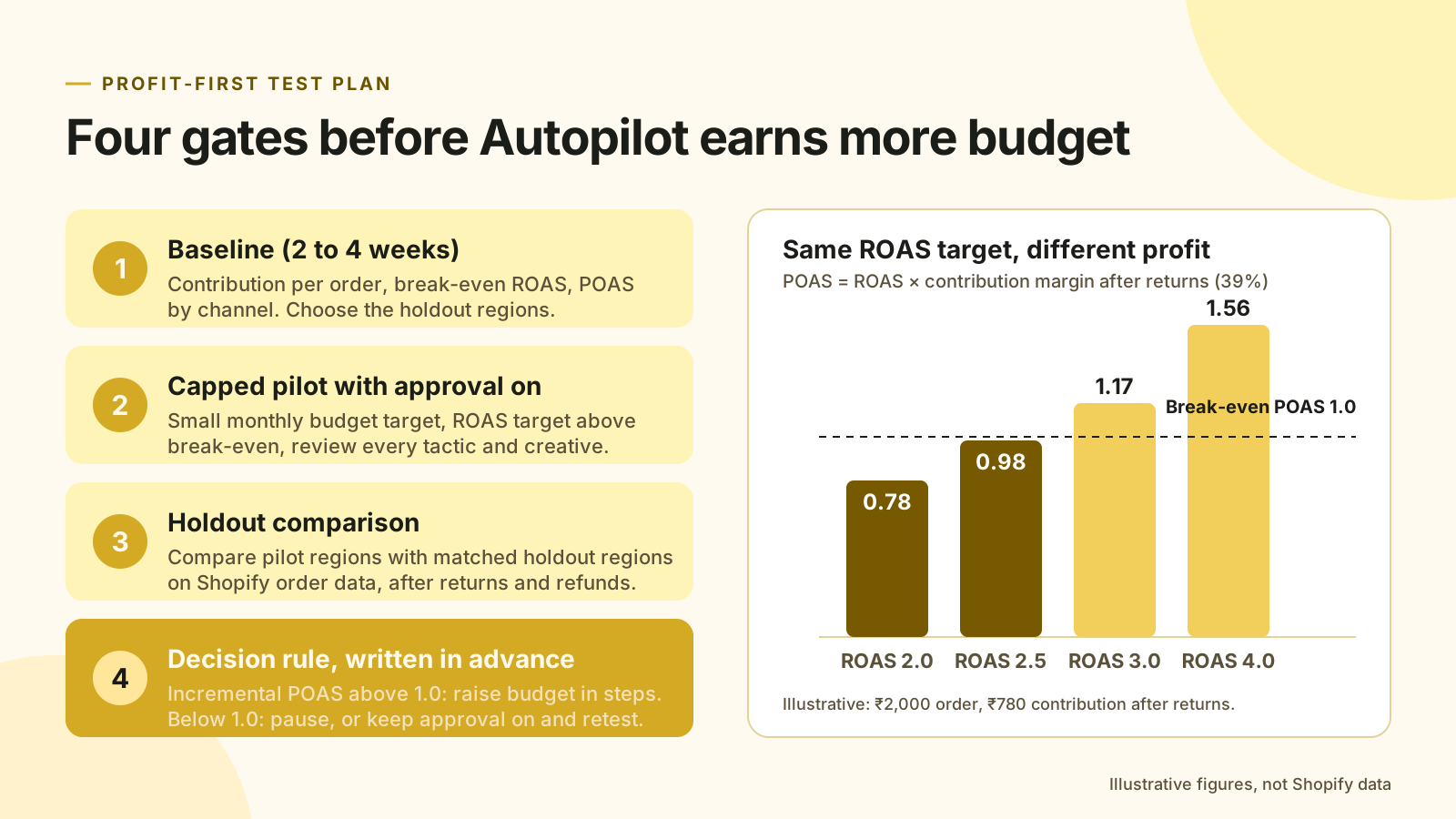
- Baseline for two to four weeks. Record contribution per order, break-even ROAS and current POAS by channel. Note your manual campaigns, because Autopilot does not change them. Our marketing budget guide helps set the spend envelope.
- Capped pilot with approval on. Set a small monthly budget target, a ROAS target above break-even, and require approval for every tactic. Shopify’s permissions let you choose whether Autopilot needs approval before it creates email and ad campaigns.
- Holdout comparison. The Help Center lists target regions as a guardrail. Run Autopilot in pilot regions and keep matched regions out of it, choosing pairs with similar sales trends in the baseline period. Keep manual campaigns identical in both sets.
- Decision rule. Write the pass mark in advance: incremental POAS above 1.0 after returns, measured on Shopify orders, not on Autopilot’s dashboard or Meta’s reporting.
Measure incrementality at platform level as well where you can. Meta describes Conversion Lift as comparing a test group that sees your ads with a control group that does not, and Google’s Conversion Lift reports incremental ROAS, but Google says to contact your account representative for access. We could not verify that either tool can be applied to Autopilot-created campaigns, so check before relying on it.
Duration matters. Shopify says results take time, and Haus’s experiments averaged 18.6 days of treatment plus an 8.8-day observation window. Plan at least three to four weeks for the pilot, then let returns and COD refusals settle before reading the result. If your customers repeat, model payback with the unit economics guide.
Guardrails and stop rules to set first
Set each guardrail from your own numbers, and assume the budget will be exceeded. Shopify documents the monthly budget as a target that can overshoot, so the practical cap is the amount you could lose without harming stock orders or cash. Check Meta Ads Manager for spend, since Shopify points there for impressions, clicks, conversions and spend.
| Control | Suggested setting | Why |
|---|---|---|
| Monthly budget target | A small slice of current paid spend, sized so a 25% overshoot is affordable | Budget is a target, not a hard limit |
| Target ROAS | Break-even ROAS plus headroom for fixed costs | Below break-even buys revenue at a loss |
| Approval permission | On for email and ad campaigns during the pilot | Shopify documents this control |
| Target regions | Pilot regions only, holdout regions excluded | Gives a matched comparison |
| Weekly review | Contribution after ads, POAS, new-customer share, returns | Shopify’s dashboard shows reach, sessions, orders and sales |
| Stop rule | Pause if POAS stays below 1.0 after the learning window | Pausing stops all running tactics immediately |
The suggested settings are our recommendations, not Shopify defaults.
Two more rules help. Keep the test away from your peak sale, because a holdout is hard to read when discounts, stock limits and traffic shift at once; our BFCM 2026 profit checklist covers that window. And if you need to cut the test, use the pause control rather than deleting campaigns, since Shopify says pausing preserves your settings.
For holiday spend specifically, see the contribution margin guide for holiday ad spend. The marketing budget calculator models the spend scenarios.
What should you check when approving creative?
Approval is your main control over what customers see, and it only works if you use it. Shopify says Campaign Autopilot uses your existing product images and catalog rather than generating new creative, so what you approve is largely a product and message choice.
Before approving a tactic, check:
- Product choice. Does it push products with healthy contribution margin, or heavy discounters and high-return items?
- Price and offer accuracy. Does the ad match your current price, shipping terms and stock?
- Stock. Can you fulfil a surge on the products being promoted?
- Claims. Does any text overstate benefits or conflict with your returns policy?
- Segment fit. Autopilot picks customer segments, and Shopify says you cannot change them, so judge the segment, not just the image.
One inference worth testing: if the tool leans on catalog images, creative variety may be thinner than a hand-built Meta account. Compare Autopilot’s results with your best manual creative before drawing conclusions. Our AI marketing workflows guide shows where human review gates belong in any AI-assisted process.
Switch it on now, test it, or wait
Campaign Autopilot may well save time, and Shopify has made its controls easy to find. What nobody has shown yet is that it makes merchants more profit than they would earn otherwise. The documented ROAS target is revenue-based, the budget can overshoot, and the independent evidence on comparable AI campaigns says results vary by brand. That leaves three sensible positions.
Switch it on now, as a pilot, if you know your break-even ROAS, have a clean baseline and can afford the budget target being exceeded. Cap the pilot, keep approval on, hold out matched regions and judge the result on incremental POAS after returns. Shopify’s own real-time analytics are a helpful way to watch orders as the pilot runs.
Test before you scale if the pilot is running but the result is not yet settled. Treat the pilot as an experiment with a pass mark. If it clears that bar, scale in steps. If it does not, you have paid a small, known price to find out.
Wait if your margins are thin, your product-cost data is unreliable, your COD refusal rates are high or you have no clean baseline. Autopilot optimises what it can see, and if your cost and returns data are unreliable, you cannot tell whether its results are real. Wait, too, if you are in the middle of a sale or a tracking migration, or if you cannot afford an overshoot. Start instead with contribution per order by channel, which the unit economics guide walks through.
If your stock decisions and ad budget are not yet linked, fix that first. A campaign tool that spends well on a product you cannot ship creates refunds, not profit.
Build the profit view before you hand over budget
MlabsGrowth helps Shopify brands connect contribution margin, POAS and AI marketing workflows, so tools like Campaign Autopilot are tested against profit, with approval steps and clear stop rules.
Frequently asked questions
Is Shopify Campaign Autopilot free?
Shopify says Campaign Autopilot itself has no additional fee. You pay for the activity it runs, such as Meta ad spend, Shop Campaigns and email sends, as you would if you ran them manually. A free tool can still lose money if the spend it directs does not return more contribution than it costs.
Does Campaign Autopilot use Google Performance Max?
Not according to Shopify’s Help Center, which lists Shopify Messaging, Shop Campaigns, Meta Ads and Microsoft Advertising as the available channels. Shopify’s product page lists ChatGPT Ads and Snapchat as coming soon. Google Ads is not on the list, so Performance Max would remain a separate, manually managed campaign.
Can Campaign Autopilot overspend my monthly budget?
Yes. Shopify’s Help Center says the monthly budget is a spend target, and Autopilot can spend above it in some cases because attribution across paid channels is delayed. Set the target at a level you can afford to exceed, and check spend in Meta Ads Manager during the first weeks.
What ROAS target should I set in Campaign Autopilot?
Set it above your break-even ROAS, which is 1 divided by contribution margin after returns and before ad spend. With a 39% margin, break-even ROAS is about 2.56, so a target of 2.5 loses money on every order. Add headroom for fixed costs and for platform-reported revenue that is not fully incremental.
How long should I test Campaign Autopilot before deciding?
Plan for at least three to four weeks, plus time for returns to settle. Shopify says results take time as the system learns, and that early cost per acquisition or ROAS can miss targets. Haus’s 640 Meta experiments averaged 18.6 days of treatment plus an 8.8-day observation window.
Source notes
- Shopify, Introducing Campaign Autopilot, published 2026-06-17, retrieved 2026-10-01.
- Shopify, Campaign Autopilot product page, retrieved 2026-10-01.
- Shopify Editions, Spring ’26, retrieved 2026-10-01.
- Shopify Help Center, Automating your marketing with Campaign Autopilot, retrieved 2026-10-01.
- Shopify Help Center, Requirements and considerations for using Campaign Autopilot, retrieved 2026-10-01.
- Shopify Help Center, Setting up Campaign Autopilot, retrieved 2026-10-01.
- Shopify Help Center, Creating and managing Meta ads with Campaign Autopilot, retrieved 2026-10-01.
- Shopify Help Center, Managing Campaign Autopilot tactics and campaigns, retrieved 2026-10-01.
- Haus, The Meta Report: Lessons from 640 Haus Incrementality Experiments, published 2025-07-28, retrieved 2026-10-01.
- Meta, Advantage+ shopping campaigns, undated vendor page, retrieved 2026-10-01.
- Meta, Conversion Lift testing, retrieved 2026-10-01.
- Google Ads Help, About Performance Max campaigns, retrieved 2026-10-01.
- Google Ads Help, About Performance Max experiments, retrieved 2026-10-01.
- Google Ads Help, About Conversion Lift, retrieved 2026-10-01.
